On a long shoot day, a hair dryer can either be a curl’s best ally or the reason a model spends the next week trying to coax their pattern back. Anyone with waves, curls, or coils knows the stakes: one rushed blast of high heat can undo months of careful care. That is why pro stylists are picky about the dryers they pack, especially when they are working with textured hair on set or in the chair.
The good news is that modern dryers are finally built with curl patterns in mind. From smart diffusers and curl‑centric blow dryers to reverse‑air tools and blow‑dry brushes, there is a clear logic to which tool suits which texture. Once you understand how heat, airflow, and attachments interact with your pattern, choosing the best hair dryer for curly hair becomes much simpler and far safer for your texture.
Why curls need a different hair‑dryer game plan
Curl experts like Nai’Vasha Grace often remind clients that curly hair does not behave like straight hair. The bends and twists that create a curl pattern also create weak points along the strand, so curls lose moisture faster and show damage sooner. That is why a dryer that feels “fine” on straight hair can leave curls frizzy, dull, and overstretched.
High heat is the main culprit. Afro and textured hair specialist Michelle Thompson notes that repeated exposure to strong heat weakens strands, causes split ends, and eventually leads to a visible loss of curl pattern. On set or backstage, where hair may be dried and restyled several times under hot lights, that risk multiplies. Pro stylists manage it by working low and slow: lower temperatures, controlled airflow, and tools that move air around the curls instead of blasting straight through them.
Key tech features to look for in a curl‑friendly dryer
Whatever your curl pattern, the right technology makes a noticeable difference. Ionic dryers are a common starting point. By generating negative ions, they help reduce static, speed up drying, and leave hair smoother and shinier. Stylists like Eugene Smith find ionic settings especially useful on thicker, dry, or frizz‑prone curls because they help lock in moisture instead of puffing the hair up.
Ceramic and tourmaline components are another curl‑friendly detail. Ceramic helps distribute heat evenly, so you do not get hot spots that scorch individual sections. Tourmaline supports shine and reduces frizz. Some newer pro dryers add infrared or light‑based drying that mimics natural evaporation; tools in this category shorten dry time while running at lower temperatures, which is kinder to fragile curls and coils.
Smart heat control has also moved from marketing buzzword to real advantage. Dryers that monitor temperature or adjust heat based on distance from the scalp, like certain Dyson models, give stylists more room to work close to roots without burning the skin or overdrying baby hairs. Whatever brand you pick, look for multiple heat and speed settings and a cool shot button so you can customize airflow for each head of hair.
Attachments are just as important as the motor. A deep bowl diffuser with long prongs cradles dense curls and coils and helps air reach the roots. Shallower cup diffusers or pronged plates suit shorter cuts and looser waves. Hand‑shaped diffusers spread air without overly lifting the root, useful when volume is not the brief. Wide‑tooth comb attachments gently stretch and detangle coils, while brush heads and round barrels are the tools of choice for smooth blowouts. Bonnet or hooded dryers still have a place for roller sets and hands‑free drying during treatments.
Matching dryers and attachments to every curl pattern
For waves in the 2A to 2C range, the goal on most jobs is soft movement without puffiness. A lightweight ionic dryer with at least one low heat and low speed setting is ideal. Pair it with a shallow diffuser to lift the roots slightly while keeping the lengths loose. When the brief calls for a blowout, a blow‑dry brush or multi‑styler with a ceramic barrel can smooth waves quickly without cranking the temperature to the maximum.
Classic curls in the 3A to 3C range usually need more support at the root and more protection against frizz. Pro stylists often reach for a full‑size dryer with a powerful but controlled motor and a deep bowl diffuser. Curl‑friendly multi‑stylers, such as updated versions of the Dyson Airwrap or T3 brush systems, add options: you can diffuse for definition, then switch to a round brush attachment if the next look demands extra height or stretch. Technique matters here; many stylists hover the diffuser around the roots until the hair is about sixty percent dry, then cup and scrunch sections into the bowl to lock in shape.
Coils and kinks in the 4A to 4C family respond best to tools that combine power with precision. Curl‑centric dryers like Pattern’s Blow Dryer are built around that idea, with strong diffusers, wide‑tooth combs, and brush attachments designed for tight textures. For fast, low‑tension stretching before braids, ponytails, or wig work, some pros also use reverse‑air dryers such as RevAir. These devices pull hair into a wand and use airflow to create tension, so coils elongate without the aggressive brushing that can cause breakage.
Diffuser, blow‑dry brush, reverse‑air or bonnet: when pros choose what
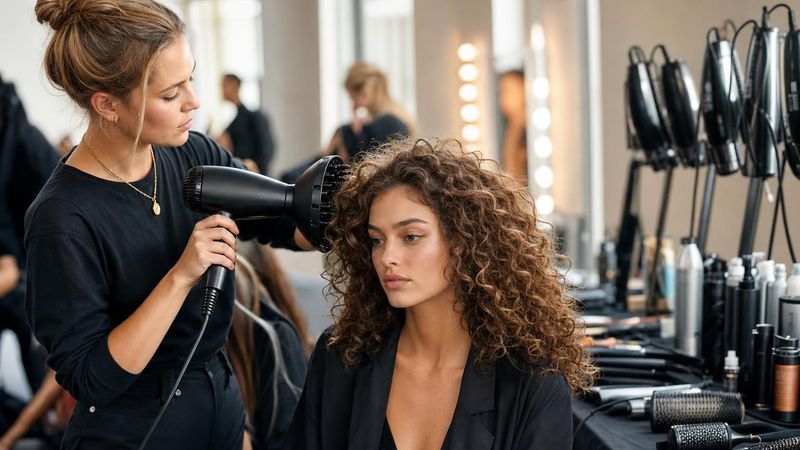
A diffuser is the default when the brief is to honor a model’s natural pattern. It spreads air over a larger area so curls dry in place instead of being blasted apart. On runway and beauty campaigns that celebrate texture, stylists rely on diffusers to build root volume and defined ends that still move under the lights.
Blow‑dry brushes and multi‑stylers come out when the creative direction calls for sleek lengths or big, bouncy “blowout” hair. Tools like the Revlon Salon One‑Step or oval barrels in kits from T3 and Dyson smooth the cuticle and add lift at the root in one pass. On curly and coily hair, pros protect the pattern by applying a solid heat protectant, working in sections, and keeping settings in the low to medium range instead of chasing pin‑straight results with extreme heat.
Reverse‑air dryers are niche but useful in session kits, particularly for dense 3C to 4C textures. They are efficient at stretching curls evenly before updos, braids, or wig prep, and they cut down on arm fatigue during long days. Bonnet and stand dryers, such as those used in salons for roller sets and deep conditioning, still earn their space when time allows; a model can sit under the hood while makeup happens, letting styles set with steady, indirect heat.
Backstage‑tested techniques to dry curls without killing definition
Product prep comes first. Stylists usually start by blotting excess water with a microfiber towel or cotton T‑shirt, then layering a hydrating leave‑in and a heat protectant suited to curls. Hair should be wet but not dripping before any dryer touches it.
For diffuse drying, many textured hair specialists follow a simple rhythm. Using low heat and low speed, they hover the diffuser near the scalp to semi‑dry the roots without disturbing the curl pattern. Once the hair is around sixty percent dry, they begin cupping sections into the diffuser, lifting toward the roots and holding for several seconds at a time. A final pass on the cool setting helps set the shape and add shine. Waves may only need this scrunching step through the mid‑lengths, while tighter coils benefit from working in smaller sections.
On set, heat and distance are constant calculations. Pros default to the lowest temperature that will get the job done in the available time and keep the dryer a few inches away from the scalp unless they are intentionally cupping curls into a diffuser. If a frizz halo appears under lights, they may flip an ionic switch on, add a touch of curl cream or serum, and finish with cool air. If wardrobe changes flatten the crown, they lift just the roots with the diffuser instead of reworking the entire head. When a previous look has stretched curls more than planned, re‑wetting targeted sections, reapplying product, and diffusing again is often enough to reset definition.