Boots carry more of a fall wardrobe than any other single item, and for Fall 2026 the talking point is not color, logo, or the must-have pair of the moment. It is shape. Across the collections that set the season, the differences that matter sit in the shaft, the heel, and the volume at the calf: leather pulled taut like a second skin, a heel so low it barely registers, a crumpled shaft that breaks at the ankle. Read the silhouette and you can tell what a season is actually doing.
That framing matters for anyone who follows fashion closely, and it matters more for models, stylists, and the people booking them. A shape that reads beautifully in a full-length image can be miserable to walk in across six hours of castings, and a boot that photographs flat can be the one that sells out. Knowing which is which is the difference between following a trend and understanding it.
Why the Shaft Sets the Season, Not the Color
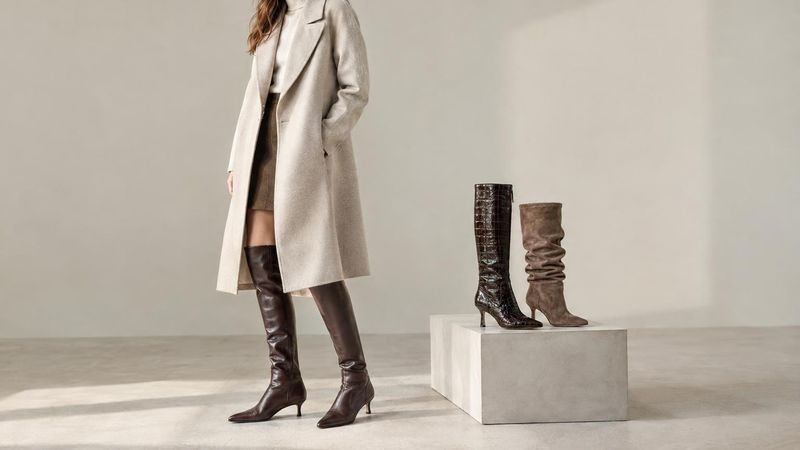
Shaft height decides where a boot ends on the leg, and that single point resets the proportion of everything above it. Extra-tall over-the-knee shapes appeared at Celine, Balenciaga, and Chloé, styled over loose trousers and against miniskirts to stretch the leg line. Slim knee-highs got the same treatment, rebuilt with structured shafts, sharper heels, and visible hardware rather than left as a plain staple.
The workable version for most wardrobes is simpler than the runway version. A boot that ends just below the knee pairs cleanly with midi hems and long coats. One that stops at the ankle resets an entire outfit and demands a different hem. Once you can read that break point, six trends stop looking like six separate purchases.
Second-Skin Leather and the Sock Boot
Soft leather sock boots turned up at Altuzarra and Chanel, then again at Celine and Calvin Klein, where they were treated as a second skin rather than an accessory. The dramatic version is taut from ankle to knee. The pared-back version keeps the sleek line but relaxes the fit slightly, which is the one most people will actually wear through a winter.
For models, this is the silhouette that forces a real conversation about fit. Sock boots are unforgiving at the calf, so showroom and e-commerce bookings tend to call for a measured sample rather than a size guess. Backstage, they also change how fast a look can be changed, which matters when a show runs on a tight rotation and a dresser is working in the dark.
Micro Kitten Heels and the Flat Boot Counterpart
Kitten heels have a definition worth knowing: roughly 1.5 to 2 inches, high enough to lift the line of the leg, low enough to walk in for hours. For Fall 2026 the category shrank further, with micro versions dipping to about 1.2 inches. Think of it as a trainer heel, a small lift that elongates without the pitch of a stiletto.
Pared-back flat boots do the same job with no heel at all, leaning on clean, structured lines instead of height. That is why they read as expensive even in a plain leather: the shape has to hold on its own, with nothing to distract from a sloppy shaft.
On set, both silhouettes are what keep a long day workable. They are also the shapes that separate a still image from a walk. A lower pitch changes stride length and posture, so a boot that looks sharp standing still can lose its line the moment a model moves.
Reptile Texture Moves From Print to Finish
Snakeskin led the reptile story last season, showing up at Khaite, Duran Lantink, and Stella McCartney. This fall, crocodile embossing joins it, which quietly shifts the trend from print to finish. Embossed leather holds its surface through wear, catches light in a full-length shot, and gives a detail crop something to sell. A printed pattern fades by comparison.
That distinction drives how these boots get photographed. Full-leg images prove the silhouette; close crops prove the surface. Campaign and catalog work usually needs both, which is why texture-led footwear tends to book well across editorial and e-commerce in the same season.
Slouch, Refined Western, and the Finishing Hardware
Slouch boots were flagged a year ahead of the curve, first seen at Isabel Marant and Louis Vuitton and now reworked at Khaite and Chloé with an insouciantly crumpled shaft. Western silhouettes got the same editing treatment at Chloé, Marni, Valentino, and Rabanne: pointed toe and angular heel kept, cowgirl decoration mostly stripped away.
Hardware sits on top of those base shapes. Buckled styles arrived at Dries Van Noten, Dior, and Ann Demeulemeester, while weatherproofing became a design feature at Miu Miu and Loewe rather than pure utility. None of these are separate trends so much as codes layered onto the six silhouettes.
Which is the useful way to plan a boot wardrobe or build a modeling book: choose the shaft and heel that match how you actually move, then let texture and hardware carry the seasonal signal. Shape is what keeps a pair in rotation after the trend cycle moves on, and it is what casting directors, stylists, and shoppers all read first.