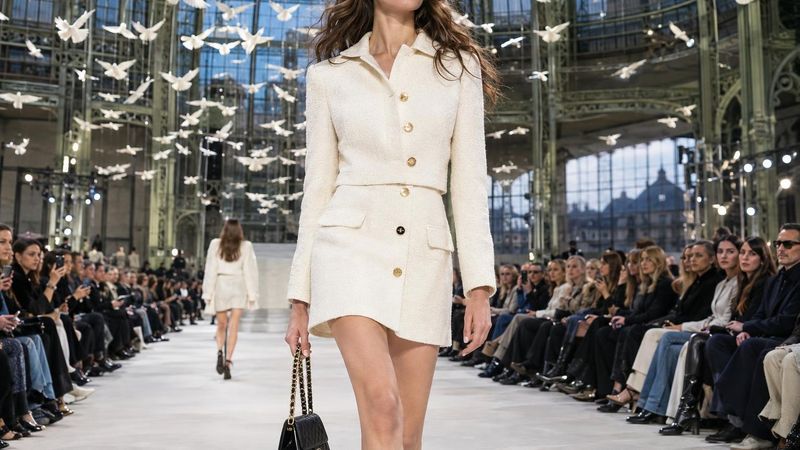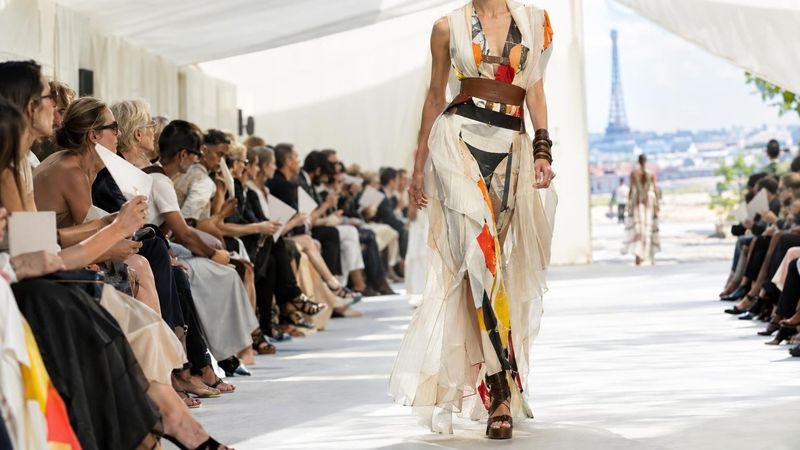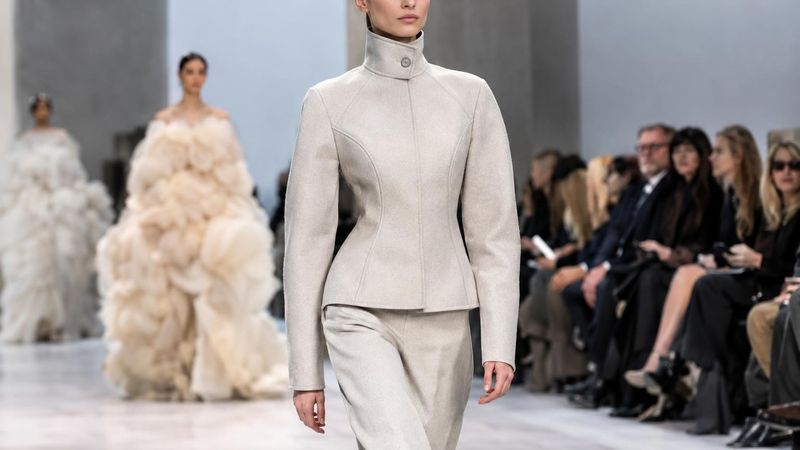
Jil Sander brought its Spring 2027 Ready-to-Wear collection to the Milan runway with a counterintuitive premise: perfection, in this house, exists only in conditions of fragility. Designed by creative director Simone Bellotti, the show has put the brand’s minimalist identity back under the industry microscope, at a moment when buyers and editors are tracking the label as closely as any collection on the calendar. The stakes are commercial as well as creative. Jil Sander sits at the center of the quiet-luxury conversation, where casting, styling, and silhouette choices read as positioning moves.
A house built on the subtraction of everything unnecessary, Jil Sander makes for a pointed case study when it reintroduces imperfection on purpose. The Spring 2027 lineup, shown on the Milan Fashion Week calendar, presents a wardrobe that appears to have been taken apart and rebuilt with visible evidence of the work. The question, as buyers and editors see it, is whether that idea registers as a deliberate house code or a single-season gesture.
Simone Bellotti’s Reassembly Method
Simone Bellotti has described the process behind the collection as a form of therapy. “Creating a collection is like going to therapy,” he explained, in a conversation published by Corriere Style. “You take things apart to understand what you want to keep, then you put them back together.” The sequence he names, disassembly followed by reassembly, works in these clothes as a method rather than a mood board.
He distilled the thought further in the same conversation: “In the face of what appears incoherent, you understand more clearly what you want.” That line explains how the collection can look loose and controlled at once. The imperfection is studied, placed where it sharpens a silhouette instead of blurring it, and the result still reads as Jil Sander from across a room.
Visible Seams and the New Jil Sander Uniform
The details are concrete. Seams trace the back of jackets, left visible where most houses would hide them. Trousers drop the usual markers of the waist. Dresses swell into cloud-like volumes, and buttoning runs severe and high, fastened to the neck. Each choice reverses a rule of the trade and then quietly restores it.
Nothing tips into chaos. Proportions stay recognizable, and the pieces end where Jil Sander pieces usually end: as a uniform that accepts personal suggestion. Fragile perfection, in this reading, turns the deliberate error into a necessary element, an aesthetic position rather than a mistake. The house’s minimalism comes out feeling human rather than sealed off.
What the Runway Casting Signals to Editors and Buyers
Casting has become the quiet second language of a show like this. A minimalist runway asks models to deliver more with less: a controlled walk, a steady gaze, composure that can register as vulnerability without tipping into drama. A Jil Sander booking carries weight in that segment for exactly this reason, and the faces a house this stripped-down chooses tell editors how the brand wants to be seen. For models building a book, this is the kind of runway where technique shows, since stride, posture, and stillness all read clearly on camera.
For buyers, the commercial read matters as much as the concept. Tailoring, outerwear, and dresses arrive with runway clarity that translates to retail, in a market that keeps rewarding quiet, well-made clothes with a visible twist. The broader signal is that Jil Sander is not stepping away from minimalism. It is pushing through it, and the industry will watch whether the studied flaw settles into a house signature.