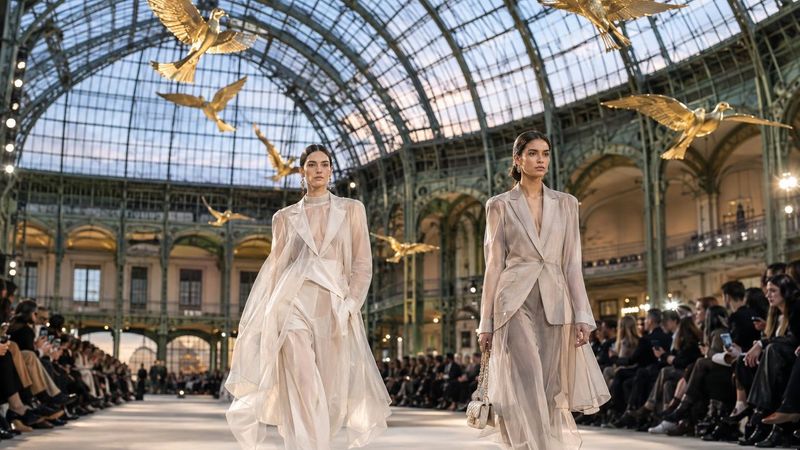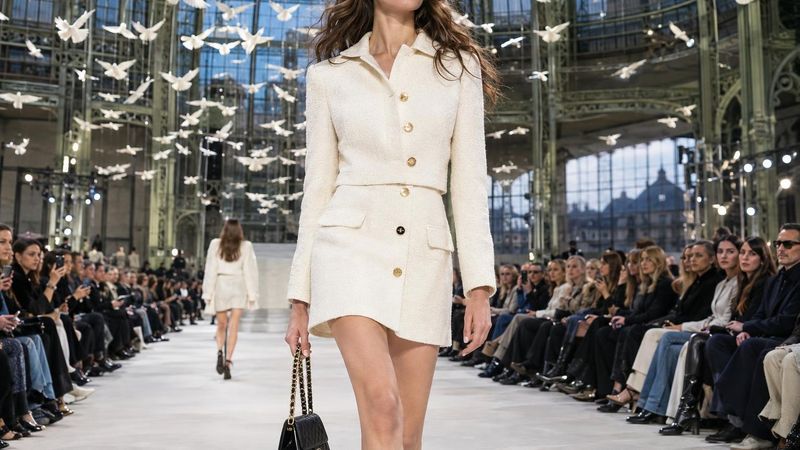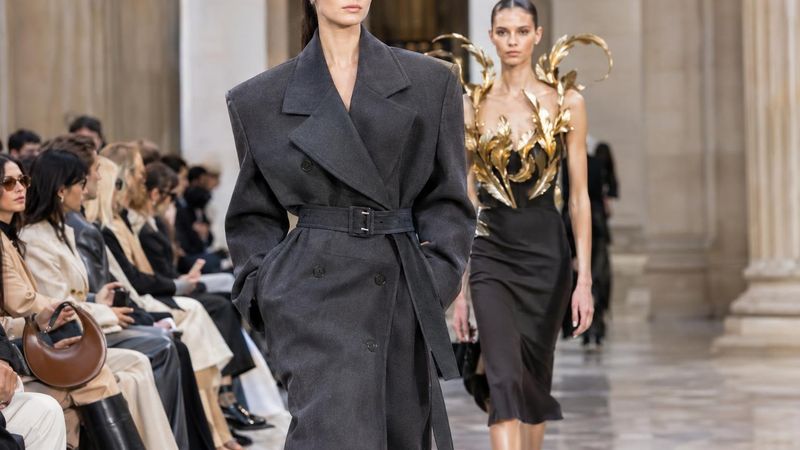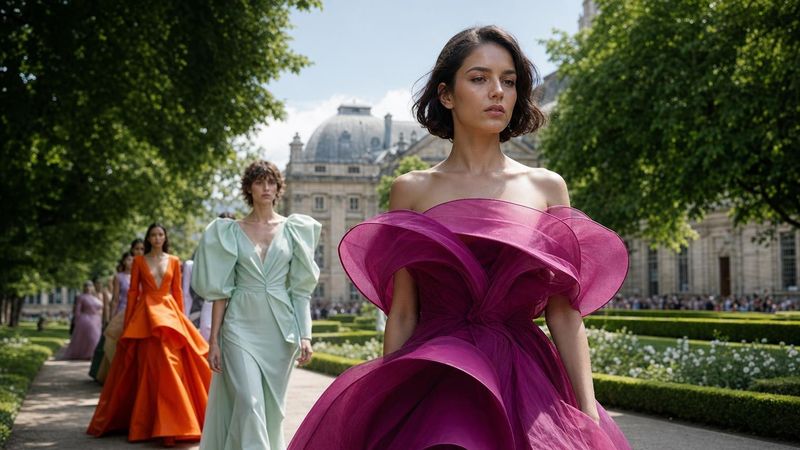
Balenciaga’s next couture chapter will not open under the crystal chandeliers of Avenue George V, but in the daylight of a Paris garden. One year after arriving as creative director, Pierpaolo Piccioli is about to show his first haute couture collection for the house, and he has started to spell out what this debut means: a return to Cristóbal Balenciaga’s rigor, filtered through his own instinctive, human-centered way of working.
For Piccioli, stepping into Balenciaga couture is both familiar and demanding. After a long, acclaimed run at Valentino, where he became one of fashion’s most respected couturiers, he now inherits a label whose founder closed the original couture house in 1968 and whose modern revival only began a few years ago. He says he connects to Cristóbal Balenciaga’s belief that a couturier must be “a sculptor, or architect for the shapes… a painter for the colors, a philosopher for how people feel in your clothes.”
Pierpaolo Piccioli takes Balenciaga couture into the garden
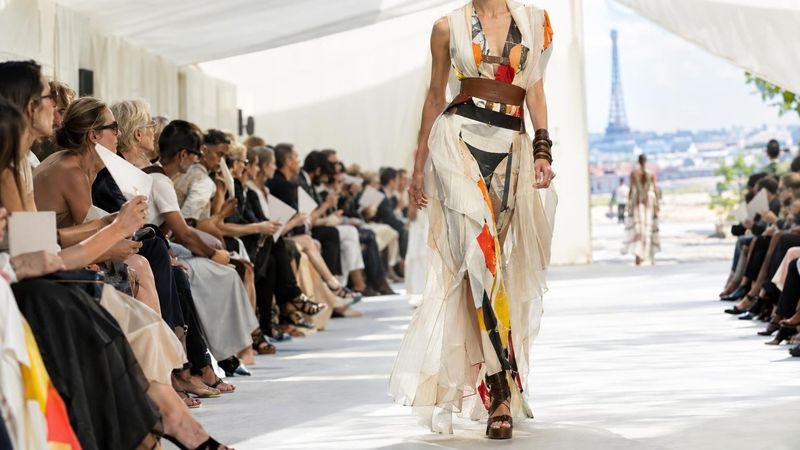
Instead of showing in Balenciaga’s restored salons at 10 Avenue George V, Piccioli is taking his debut couture collection outdoors, to the Cité Universitaire in Paris’ 14th arrondissement. The clothes will walk through a formal garden at midday, in open air rather than under gilded ceilings. “I wanted to have couture related to the moment,” he explains. Seeing the pieces move against trees and grass, with real daylight on the fabrics, is his way of making couture “more real” and “more related to life.”
The format shifts too. Recent Balenciaga couture shows were coed; Piccioli is starting with women only. He says it felt important “to redefine a vision of a woman in couture here,” built on ease and effortlessness. Expect garments that can be extravagant yet styled with everyday wardrobe pieces, and a fusion of sharp tailoring with fluid flou. For models, that usually means looks where walk, posture and attitude matter as much as fantasy, because the clothes are meant to live beyond the runway.
Inside Piccioli’s Balenciaga couture method
Piccioli began the collection last October and November, working through toiles, experiments and research with the Balenciaga couture atelier. One look took six to seven months to perfect. He talks about starting from drawings but letting instinct take over once he is in front of fabric and color. He keeps returning to Cristóbal’s “conversation with the body,” focusing on lightness, movement and the negative space between body and cloth. Cuts are engineered to rely on as little internal structure as possible, so fabric, shape, color and surface feel like one gesture.
That thinking also guides his use of decoration. He notes that Cristóbal Balenciaga rarely used flowers in a pretty, romantic way; they were bold, almost abstract surfaces applied to very pure shapes. Piccioli is picking up that tension between maximal surfaces and minimal lines. Inside the atelier, he is working with a notably young team compared with his Valentino years. He likes their open mindset, and talks about fusing their skills in tailoring and flou in ways they “never experienced in the past.” He insists you cannot just arrive and impose a vision; you have to involve the people who sew the clothes so that their technique and their passion both show up in the work.
Why this Balenciaga couture debut matters now
Piccioli describes couture as “the laboratory of experimentation, innovation and challenges” and calls it the soul of the company. The aim is not to make untouchable museum pieces, but to use couture thinking to change how every category is made, from gowns to T-shirts and denim. He says he does not believe in “elevation of garments” so much as in keeping clothes authentic to what they are, but engineered in the best possible way. At Balenciaga, he has already tested that direction in ready-to-wear, reintroducing Cristóbal-era silhouettes like sack and baby-doll shapes with calm, geometric lines.
He has also been clear that he is less interested in literally reviving archives than in reviving Balenciaga’s values: freedom of the body, precision of cut, a sculptural approach to volume. For the modeling world, this debut is likely to signal a shift from shock-driven runway moments toward silhouettes that reward presence, grace and the ability to animate strong, architectural clothes. With couture stepping into a garden and brushing up against “daily” pieces, the looks are built to move on red carpets, in editorials and campaigns. That makes Pierpaolo Piccioli’s first Balenciaga couture show not just a house reset, but a reference point many casting directors and image-makers will watch closely.