The bandana kerchief has quietly moved from vacation afterthought to the hair accessory of the mid‑2020s. The classic triangle of cotton or silk, tied over the head, is suddenly everywhere: on Rihanna at airport arrivals, on Kim Kardashian in off‑duty photos, on Dua Lipa’s honeymoon posts, on Zendaya ducking into a bookstore. For stylists and models, it is no longer just cute – it is direction.
What makes this small square so powerful is the way it frames the face, edits the hair, and pushes a whole beauty mood in one gesture. Worn low over the forehead, pulled back to show the hairline, or knotted over a bun, the bandana kerchief changes proportions the way a good haircut or brow shape does. That is why it keeps turning up in summer campaigns, editorials, and street‑style shots, not just on beach days.
Why the bandana kerchief owns summer hair right now
If 2025 made room for scarf skirts and sarongs, the following seasons have clearly belonged to the bandana kerchief. Stylists like it because it solves real heat problems: it keeps hair off the face, protects color from the sun, and hides roots or day‑two texture without feeling overproduced. On location, it is a fast reset when humidity hits curls or bangs start collapsing.
Celebrities are essentially demo reels for how it works. Kim Kardashian’s cherry‑red bandana worn low on the forehead sharpens brows and lashes. Elle Fanning and Amelia Gray, by contrast, push the kerchief back to reveal the hairline, letting pieces fall around the temples for softness. Dua Lipa ties sky‑blue and navy versions with swimwear, while Zendaya wraps a navy bandana over a bixie cut, turning short hair into a graphic shape that reads clean in photos.
A visual history that keeps feeding moodboards
The bandana’s power as an image is not new. It originated as a printed square in India, with its name linked to the Sanskrit “bandh,” meaning “to tie,” before traveling to Europe through trade. In the United States, bandanas were used as early political merchandise from the era of George Washington through multiple presidential campaigns, printed with portraits and patriotic motifs.
By the 1940s, Rosie the Riveter fixed the red kerchief in fashion memory: hair wrapped up, knot at the top, a symbol of women at work. Rock icons later picked it up differently, folding it as a forehead band on stage; Axl Rose and Bruce Springsteen turned the red paisley strip into a rock signature. In hip‑hop and R&B through the 1990s and early 2000s, artists like Tupac Shakur, Aaliyah, Beyoncé, and Missy Elliott pushed the kerchief in every direction, from low‑slung triangles to rhinestoned versions. When stylists reach for bandanas today, they are pulling from all those archives at once: workwear, Americana, rock, and Y2K.
Placement is the story: how celebrities wear the bandana kerchief now
On current red carpets and candids, four placements show up again and again. Worn low on the forehead, almost touching the brows, the kerchief shortens the face and makes eyes and lashes the focus. This works for strong liner and heavy mascara, and for shoots that want a little attitude or anonymity. A bold red or navy paisley here evokes classic Americana without looking like costume when the rest of the look stays minimal.
Pulled back to show the hairline, the bandana becomes softer and more “French girl.” Elle Fanning, Amelia Gray, and Zendaya all wear it this way, letting bangs, money pieces, or baby hairs show. The triangle starts just behind the front hairline, with the knot tied low at the nape. It flatters bobs, bixies, and lobs because it lets the cut’s outline stay visible while still taming the crown.
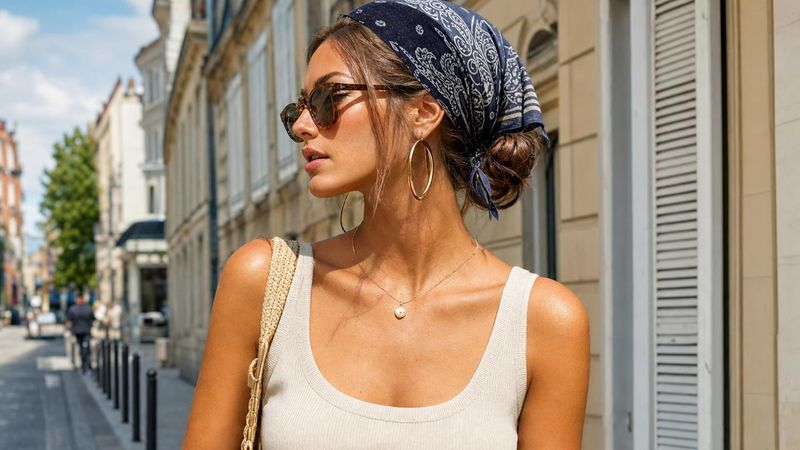
Wrapped over buns and updos, the kerchief turns into a frame for the neck and shoulders, which is why it appears so often with swimwear and strappy dresses. Gigi Hadid’s white‑and‑navy kerchief over a bun is a good reference: hair is controlled, the knot sits under the bun or at the nape, and the focus moves to collarbones and jewelry. This pose photographs especially well in profile and three‑quarter views.
There is also the narrow, folded‑strip option: think Serena van der Woodsen‑style headband, Jackie O’s under‑the‑hair tie at the neck, or a cowboy triangle flipped and tied looser. A wide band folded from a square can sit like an Alice band with the knot hidden underneath, leaving curls, braids, or a low ponytail free. On natural textures, this approach respects volume while still giving that kerchief reference.
On-set cheat sheet: turning a scarf into hair and beauty direction
For hair direction, the bandana kerchief is most useful when it is planned alongside cut, texture, and make‑up instead of thrown on at the last minute. Short crops and bixies take a low‑forehead tie particularly well, because it exaggerates cheekbones and jawlines and avoids the “helmet” effect. Mid‑length and long layers usually benefit from the hairline‑showing placement or a bun wrap so that some movement still reads on camera.
Color and print choices shift the entire beauty story. Classic red or navy paisley leans into Americana; sky blue, white, and sand feel like Riviera holidays; black or chocolate brown in silk instantly looks more city and polished. Strong patterns near the face pair best with clean, graphic make‑up (sharp liner, defined brows, neutral lips), while solid or tone‑on‑tone kerchiefs leave room for bolder eyeshadow or gloss.
On a summer shoot, it helps to treat kerchiefs like a mini styling kit rather than a single hero piece:
- Pack a range of sizes, from small squares to generous triangles, in cotton for grip and silk for drape.
- Test prints on camera beforehand to avoid moiré or distracting detail in close beauty shots.
- Plan at least two placements per talent – for example, low‑forehead for tighter portraits, then hairline‑showing or necktie for wider, more relaxed frames.
- Use the same bandana beyond the head: once hair comes down, move it to the neck, wrist, or bag handle to keep continuity across looks.
- Always check comfort; a kerchief that is too tight or too hot will read in a model’s posture and expression.
For models and aspiring talent, mastering a few bandana kerchief options is an easy way to bring ideas to set. It signals you understand face framing, references from Rosie to Rihanna, and how one accessory can pivot a whole beauty mood. Whether it is a red paisley folded low or a pale silk triangle just skimming the hairline, the bandana kerchief is likely to stay in rotation every summer precisely because it does what good direction does: it tells a clear, instantly readable story in one simple move.