The MTV Video Music Awards have never been the carpet where stars play it safe. The 2026 ceremony, held Sunday, Sept. 27, at the Peacock Theater in Los Angeles and hosted by Snoop Dogg, kept that reputation intact, with a guest list that treated the step-and-repeat as a place to take a real fashion swing rather than a safe sponsorship obligation.
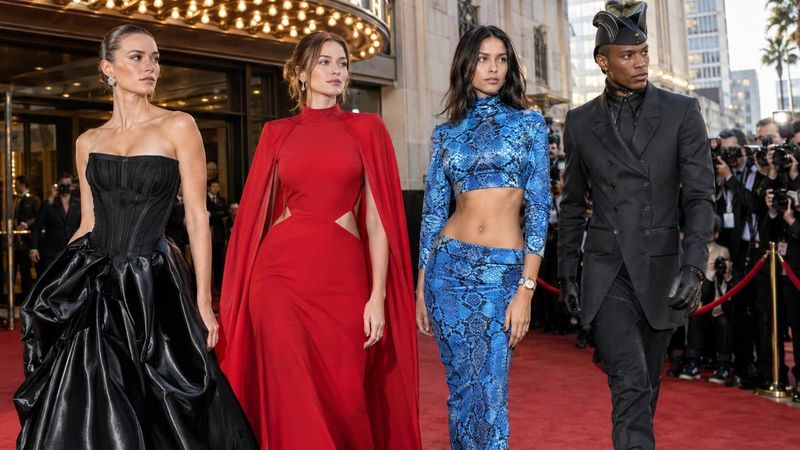
Black dominated, but it was a dressed-up, dramatic black: lace, corsetry, and sculpted tailoring rather than minimalism. Where color broke through, it broke through hard, in a red statement dress and an electric-blue snakeskin set that pulled the night’s most 2000s-inflected reference. Here is the credit-by-credit read on the looks that mattered, plus the one runway moment that ties the whole night back to the modeling calendar.
The Headline Looks and the Designers Behind Them
Taylor Swift arrived in a Tamara Ralph corset dress with a disco-ball skirt, finished with Le Silla shoes and a stacked jewelry lineup from Leviev, Anita Ko, Forever Diamonds, and Etho Maria. The construction did the work here: a structured bodice up top, high-shine movement below.
Teyana Taylor went full-length black in a deep-V Zuhair Murad lace design. Charli xcx stayed in the same palette with a cropped Saint Laurent skirt set by Anthony Vaccarello, styled with Fope jewelry. Lisa broke the black run in a red-hot The Attico dress topped with a matching Quine Li cape and Rainbow K jewelry. Tyla leaned into Y2K in an electric-blue snakeskin-print Mowalola bra top and low-rise skirt, with a Chopard watch worn as an anklet.
Sharp Tailoring and Custom Couture Do the Heavy Lifting
The night’s strongest non-gown moment came from Troye Sivan, who wore an Erdem spring/summer 2027 look built around an equestrian reference and a dark romantic mood.
Adam Lambert commissioned custom Charles de Vilmorin Couture and finished it with a Philip Treacy headpiece, while Sombr went custom ERL and Sienna Spiro chose custom Valentino with Chopard jewelry. Elsewhere: Paris Hilton in The Blonds, Raye in Georges Hobeika, Bella Poarch in a Victorian-inspired Dreaming Eli look with visible corsetry and boning, JoJo in Nué, Megan Lawless in Bach Mai, Rei Ami in HILÁ, and Stella Lefty in Claire Pettibone. PinkPantheress wore Nina Ricci and Normani wore Robert Wun.
Runway to Red Carpet, and Why That Pipeline Matters
Troye Sivan’s Erdem look arrived fresh off the spring/summer 2027 runway, which is the detail worth watching if you follow how fashion actually moves. A look that walks a show and then reappears on an awards carpet weeks later signals a house pushing a specific silhouette into the wider conversation, and it usually means the model who walked it is now attached to an image circulating well beyond the show audience.
Credits like these get built through a familiar chain. A stylist pulls from a showroom, a house agrees to a custom commission, or a jewelry brand loans pieces for the night, and every element gets confirmed separately. That structure explains why some attendees land on best-dressed lists with a full credit line while others appear with a single house name or none at all. For aspiring models, the takeaway is straightforward: carpet credits are the visible end of a working relationship that starts at castings and fittings, long before anyone steps in front of a photographer. Note also that Dakota Johnson, who wore Calvin Klein with Messika jewelry, appeared on stage only, so she sits outside the carpet gallery proper.
What the 2026 VMAs ultimately delivered was a carpet split cleanly in two: dramatic dark dressing on one side, statement color and sharp tailoring on the other, with corsetry as the connective thread running through both.