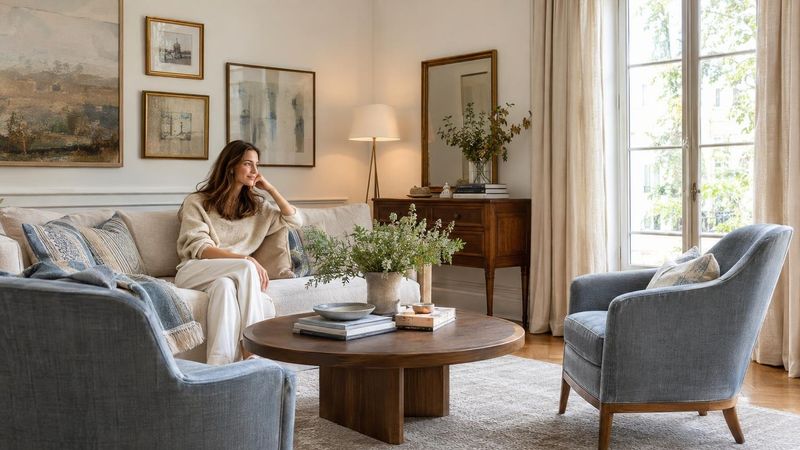
A transitional living room is not a compromise between old and new. It is a deliberate mix of pieces from different eras, held together by a quiet palette and consistent proportions, so that no single style announces itself first. That is the definition, and it is also the test you can run on every piece you bring in.
Getting there takes order. The sequence below follows the way a designer actually works: read the architecture, plan the layout, lock the base pieces, then introduce contrast through shape, material, and light.
Start With the Architecture, Not the Furniture
“Transitional-style design is about bringing together styles and design from different eras, but in a cohesive, balanced and effortless way,” says George Townsin, director at Studio George. “You want to walk into the room and not be able to immediately pinpoint any particular style or era. There is a timeless quality to it.”
That idea shapes every decision that follows. Begin with the bones of the room. Decorative millwork, paneling, and a traditional fireplace already supply character, which frees you to keep furnishings simple: contemporary or mid-century pieces look sharp against ornate architecture. A plain, builder-basic room runs the other way, and one or two traditional pieces, such as a vintage console or a classic armchair, add the history the space is missing.
Then choose a single focal point and arrange around it. A fireplace, a large window, or a substantial piece of art gives the seating group something to face and keeps the layout from drifting.
Plan the Layout, Then Anchor the Room
A sofa facing two chairs, angled slightly inward around a coffee table, is the most dependable transitional arrangement. It creates a clear conversational center and lets the chairs bring in a different profile. A sectional works too, as long as its back and arms are defined and proportionate to its length.
Working measurements: the sofa should span roughly two-thirds of the wall behind it, with 14 to 18 inches between it and the coffee table and 30 to 36 inches of clear walkway through the room. Treat these as rules of thumb and check your own traffic paths before you commit to a length.
The rug sets the whole group. Bring the front legs of the main seating onto it, which visually merges pieces that do not match. A low-pile or flat-weave rug in a subdued pattern keeps the surface calm. For the sofa itself, look for a neutral solid or textured fabric, a clean frame, and a modestly softened arm. That quiet anchor is what lets everything else be interesting. Close the base with warm white or taupe walls; Sherwin-Williams Alabaster and Benjamin Moore White Dove are useful starting points to sample in your own light.
Mix Eras With Shape and Material
Contrast is the goal, drama is not. “Pulling accent chairs from different eras is a great opportunity to balance modern and traditional,” says Chantal Martinelli, architect and co-founder of Mad Atelier. Keep those chairs cohesive through shared forms or materials so they read as a pair rather than two separate ideas.
Jessica Schuler of J Renee Designs offers a practical shortcut: go modern for upholstered furniture and slightly traditional for hard pieces. A handsome cabinet, console, mirror, or side chair adds personality and history without taking over. Traditional furniture tends to be bulky, which is fine, provided the rest of the seating stays sleek and low-profile to offset it.
Mix shapes on purpose. Pair a straight-armed sofa with rounded-back chairs, or a rectangular sofa with a round or oval coffee table. For the table itself, an open base keeps heavy upholstery from feeling heavy, while a solid wood top gives slender chairs more presence.
Keep the Palette Quiet and Let Texture Work
Stay neutral for the field color, then add exactly one accent hue. Blue and green are the safest choices. “The injection of a pop of color is essential, better if only in one full hue,” says Cinzia Moretti of Moretti Interior Design. Martinelli favors tones that are “bold but not vibrant,” drawn from a vintage palette, because they hold pieces from different eras together without competing.
Pattern follows the same logic: one large-scale pattern at most, usually on a rug or drapery, plus a smaller pattern on pillows. Two full-strength patterns in one room start arguing with each other.
Texture is where a neutral room earns its keep. Layer a textured rug under a linen sofa, then bring in velvet, bouclé, and silk on pillows. Curtains in linen or raw silk read as timeless against both traditional and modern furniture, and full-length panels that stack past the window add height without adding ornament.
Layer the Light, Then Know When to Stop
Light in three layers: a central fixture, wall or floor lamps around the seating, and accent light on art or architecture. Metallic finishes are “the jewelry of the space,” says Schuler, and one is usually enough to dress the room up. She also notes that lighting is the element homeowners most often overlook when decorating on their own.
Finish with art and objects arranged asymmetrically, varied in size and unified by muted color. Then apply the stop rule. Jill Higgins of Studio Jill suggests sticking to one or two periods contrasted against contemporary pieces, and Townsin warns against trying to fit every era you love into a single room.
The most common failures:
- Buying matching sets, which read as showroom stock
- Oversized rolled arms and deep cushions that push the room back toward heavy traditional
- Three or more competing patterns
- A neutral room with no texture at all
- Decorating every surface, when clear space is part of the style
Buy in this order: wall color and rug first, then the sofa, then chairs and tables, then lighting, then textiles, then art. Fixing the largest visual element in the room, which is usually the rug, shifts the result further than several small purchases combined. A room built this way can absorb new pieces over years and still feel like one considered space.