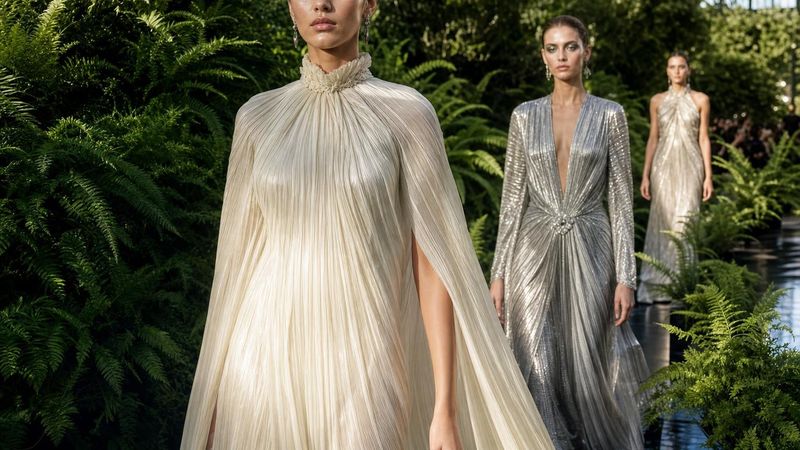
On July 6 in Paris, Christian Dior unveiled its Fall/Winter 2026–2027 haute couture collection, the second couture outing by Jonathan Anderson and one of the most closely watched shows of the week. Guests arrived to find the show space transformed into a dense fern-filled greenhouse, with a black lacquer runway that gleamed like a wet forest floor. From the first look, it was clear the house wanted to talk about growth, structure, and how far Dior’s silhouette can stretch.
The Christian Dior Fall 2026 couture show revolved around one almost obsessive idea: pleats as architecture, not decoration. Across roughly 65 looks, Anderson used folds the way other designers use seams or boning, building waists, columns, and sweeping skirts that seemed to unfurl like fern fronds from the ground up. The result felt stricter and cooler than the brand’s usual romanticism, which raises an obvious question for models and clients alike: is this the new outline of Dior glamour?
Inside Dior’s fern-filled couture forest
Staged in an official Fédération de la Haute Couture et de la Mode slot in mid‑afternoon, the show pulled audiences into a controlled, almost laboratory version of nature. Ferns rose in thick borders around a dark central “box,” so each model stepped out of shadow into a band of greenery and reflected light. On camera and in person, looks appeared to grow out of the black floor, an effect that sharpened every line and pleat.
The fern became more than set dressing. Its spiral growth pattern echoed through the way skirts twisted around the hips and how sleeves curved away from the body before tapering back in. References to Madame Grès and Mariano Fortuny surfaced in the long, columnar gowns, while a finale bridal look – a pale, fern‑embroidered column with a lightly textured train – condensed the story into one dress. It read as a thesis on couture as patient, botanical construction rather than instant drama.
Pleats, metal and the new Dior silhouette
Instead of cycling through multiple themes, Anderson stayed with a single structural language. Pleats cinched the waist in place of corsets, built peplum‑like volumes without stiff underpinnings, and fanned out into trains that moved in slow, deliberate waves. The traditional Bar jacket vocabulary was still there in spirit, but translated into grooves and ridges rather than padding and nipped tailoring.
The palette followed that discipline. Ivory, cream, greige, and black dominated, cut through with controlled flashes of leaf green that echoed the set. Metallics arrived as sculptural surfaces more than sparkle: crushed silver and pewter lamés clung to the body like molten metal frozen mid‑flow, a clear nod to artist Lynda Benglis and her poured forms. For red carpet stylists and editorial teams, these looks offer a different kind of Dior moment – less princess, more statue – that asks for models who can sell stillness and strength as much as movement.
Beauty and casting: the faces of Fall 2026 couture
Backstage, Dior Makeup creative and image director Peter Philips kept faces almost bare, with luminous, lightly perfected skin and very little visible contour. The headline detail was the eye: a metallic chartreuse‑to‑sage wash, built from shades in Dior’s upcoming Fall 2026 palette, pressed over the lid and into the inner corner. Under the show lights, that green‑gold flash caught just as each model stepped from the dark box into the fern halo, tying beauty directly to the set. Off‑runway, the same idea works toned down with a single olive shimmer on the lid and neutral lips.
Casting director Ashley Brokaw assembled a high‑impact lineup that matched the collection’s focus. Laura Kaiser opened the show, setting the measured, almost ritual pace the long pleated columns demanded, while Kaja Krawczyk closed in the fern bride. In between, established runway stars like Fei Fei Sun and Mona Tougaard walked alongside newer faces, underscoring Dior’s mix of authority and fresh energy. For models, this kind of couture is less about big gestures and more about control: managing weighty metallic gowns on a slick, lacquered floor, keeping pleats perfectly aligned, and letting that metallic green eye do much of the talking as cameras zoom in.
With this Fall 2026 couture chapter, Anderson narrows Dior’s message into a cool, structural line that feels designed for both the lens and the fitting room. The pleated forest, the molten gowns, the chartreuse gaze – all of it sketches out the image clients will associate with the house’s campaigns and editorials over the next seasons, and the kind of faces they will expect to see wearing Dior at the very top of the fashion pyramid.