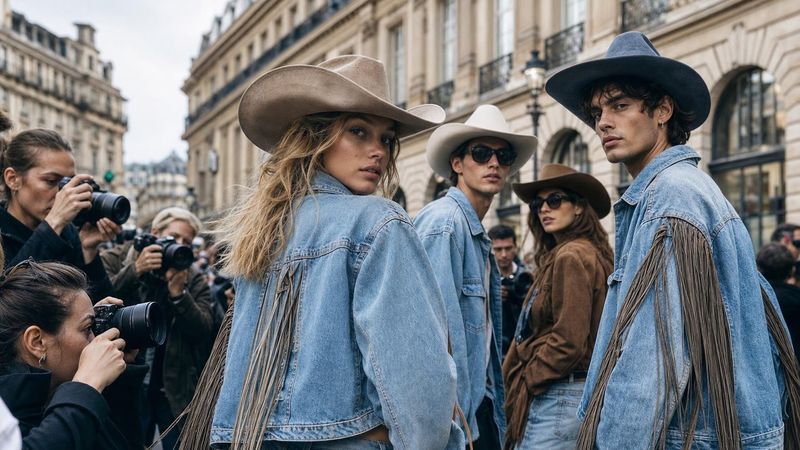
Cowboy hats outside a Paris menswear show, glossy boots at Pitti Uomo in Florence, double denim in Milan street-style galleries. Those Western touches keep popping up around Fashion Week, and they are no longer just fun background details. Cowboy-inspired street style has turned into a serious reference point that shapes who gets booked and how Western-core campaigns look once they go from deck to shoot.
As brands lean into Western-core and cowboy-core briefs, casting boards are filling with faces that can sell a hat, a boot and a sense of modern Americana all at once. Street style is where teams quietly test what that looks like in real life: which silhouettes feel aspirational, which feel like costume, and which bodies and identities audiences clearly respond to.
For models and creatives, understanding that pipeline from sidewalk to moodboard makes Western-core feel less like a passing meme and more like a language you can work in.
Why Cowboy-Inspired Street Style Became a Serious Casting Signal
The industry’s latest Western wave did not come out of nowhere. Luxury houses have been circling the theme for years, from Maria Grazia Chiuri’s resort 2019 “Diorodeo” collection at Dior to Alessandro Michele’s eccentric equestrian codes at Gucci. Those shows planted the idea that a cowboy hat or a pair of jodhpurs could sit comfortably in a high-fashion context.
From around fall 2022, street photographers in Milan, Paris and Florence started documenting a clear pattern: cowboy hats outside spring 2023 shows, tall riding boots with tailoring, breeches and chaps mixed into everyday outfits, leather vests layered over denim. The looks kept returning across seasons up to at least 2026 menswear, which tells brands this is not a one-season stunt.
Consumer data points in the same direction. One fashion report tracked a jump of about 240 percent in new cowboy boot and denim shirt styles introduced by US and UK retailers in a single year. Resale platform Depop saw searches for “western” items rise by roughly 15 percent in 2023. Layer on pop culture moments like Beyoncé’s country-leaning album era, Lana Del Rey’s upcoming country record, Western-coded fan outfits at Taylor Swift and Harry Styles concerts, and Bella Hadid posting in a black cowboy hat, and you get a visual environment where Western-core feels familiar, not risky.
From Sidewalk to Moodboard: How Western-Core Street Style Travels Inside Brands
Every cowboy-coded outfit snapped outside a show can end up influencing a campaign six months later. Street-style galleries, TikToks from the venue queue and paparazzi shots of off-duty models are constantly being saved into private folders by stylists, assistants and junior art directors. Those images sit next to runway stills from Louis Vuitton’s Western-inflected fall 2024 menswear show, Diesel, Dsquared2, Ganni or Chanel couture with a country twist.
When a client brief lands with a line like “Western-core, but modern and global”, those folders become the starting point for a creative deck. Teams cluster references into micro-stories: an urban cowboy in dark denim, a festival cowgirl in fringe and metallics, a luxury equestrian mood with tailored jackets and knee-high riding boots, a stripped-back ranchcore look in sun-faded denim and suede. Street style helps answer key questions fast: how oversized can the hat be, how low can the jeans sit, how far can they push color without losing the Western read.
Because these looks are worn on real sidewalks, not just runways, they are invaluable for judging proportion and practicality. If a certain boot height or belt hardware keeps showing up outside shows and at airports, creative teams feel safer building it into a commercial campaign.
The New Western Archetypes Recasting Cowboy-Core Campaigns
For a long time, fashion’s cowboy archetype looked suspiciously close to a single reference: the Marlboro Man, with the occasional pin-up cowgirl. Cowboy-inspired street style has blown that universe wide open. Recent Western-core campaigns feature a broader mix of genders, body types and ethnicities, mirroring the fans who show up to concerts and Fashion Week in boots and hats.
On the page, that shift looks very concrete. Casting notes now refer to archetypes like “city cowboy”, “festival cowgirl”, “quiet rider” or “rodeo glam lead” rather than one generic cowboy. Each one maps to a handful of styling codes lifted straight from the street. Classic stacked-heel boots and heavy bootcut jeans signal a ranch-adjacent mood. A crisp snap-front denim shirt and vintage belt buckle lean into heritage. A sharp black hat with a tailored suit reads nightlife cowboy for a luxury brand. Fringe jackets, shearling coats, studded belts, bolo ties and layered turquoise jewelry all plug into these archetypes like visual shorthand.
Agencies assemble casting boards that mix clean comp-card images with more characterful shots where talent has already worn some of those elements, whether at a festival, a show or a test shoot. A model who reads believable in double denim and boots, moves naturally in a hat and can project a “road trip still” without overacting suddenly looks right for a whole category of Western-core work.
What Western-Core Means for Working and Aspiring Models
You do not need to rebrand as a full-time cowgirl or cowboy to tap into this moment. For most models, the opportunity is to show you can plug into Western-core when a client needs it, then switch back to clean minimalism or sportswear the next day. That usually means adding one or two subtle Western-leaning images to your book rather than filling a whole portfolio with lassos and saloon doors.
Simple test ideas work best: good denim, a T-shirt or plain shirt, well-cut boots, maybe a leather belt with a bit of hardware. Let the fit and proportions do the Western talking instead of going head-to-toe costume. Hair and makeup can stay modern and polished so the images still fit a variety of brand worlds, from beauty to denim to mid-luxury.
Movement matters too. Clients notice if you can walk confidently on gravel in boots, handle a long coat in the wind, or use a hat as a prop without hiding your face. Any background in riding or dance often translates into better balance and posture, which suits both cowboy-core and equestrian-flavored shoots. On social media, an occasional Western-coded look at a concert or fashion event can also be a quiet signal to casting teams that you understand the vibe, as long as your grid still shows range beyond that one aesthetic.
How Long Western-Inspired Street Style Stays on the Casting Board
Western references have always cycled in and out of fashion, but the run from Dior’s 2019 “Diorodeo” through the 2024–2026 Western-core wave, combined with the retail investment in boots, hats and denim shirts, suggests cowboy-inspired dressing is settling into the same category as preppy or utility. It may spike and soften, but it rarely disappears entirely.
Over the next few seasons, some of the louder cowboy-core looks seen on the street are likely to evolve into quieter cues: a certain boot shape, a studded belt, a yoke on a shirt or jacket, a hint of fringe. Brands will keep pulling Western-core out of the reference folder whenever they want to talk about freedom, road trips, resilience or roots. For models, bookers and creatives, staying fluent in that visual language means keeping a small but current bank of Western-friendly images and references ready for the next time a brief asks for “cowboy-inspired, but make it now”.