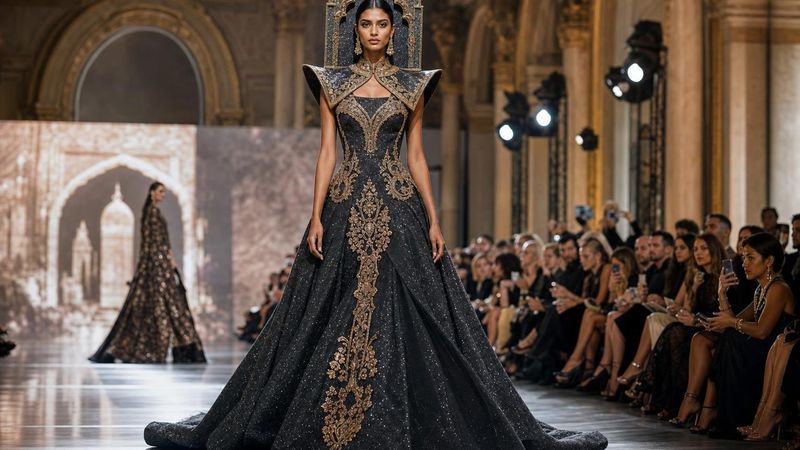
At 5 p.m. in Paris, Rahul Mishra turned the Fall 2026 couture runway into a shrine to Indian temple art. The collection, titled Devi, is how the Indian couturier describes his “most India-inspired” work yet, an almost literal act of time travel from Ajanta and Karnataka to the Fédération’s official haute couture calendar.
Instead of airy fantasy, Mishra offered dense, sculpted looks that treated models like living statues. Front row, Cardi B and Isha Ambani watched in custom Devi creations, a reminder that what happens on this runway rarely stays there for long. It is a collection aimed at both museums and red carpets, and it shifts the conversation around what Indian couture can look like in Paris.
Rahul Mishra Fall 2026 Couture: Devi as temple sculpture
The research trail behind Devi runs through the Ajanta Caves in Maharashtra, a 12th century stone dancer, and the Tarakeshwara Temple in Karnataka. Mishra fixated on how those sculptures carve draped fabric directly into stone and how jewelry seems built into the body. “This is all about celebrating the body,” he said, recalling eras when there was “no idea of covering the beauty of the body,” only revealing its lines through carved folds and ornaments.
On the runway, that scholarship read as a series of temple deities stepping off their plinths. Arched motifs referenced temple doorways, looping patterns framed shoulders and hips, and several looks carried the matte aura of black granite or burnished copper. One standout had the model’s head flanked by sculpted faces and topped with a stonelike headdress, pushing the statue idea to its extreme. The palette stayed close to stone and metal – gray, black, gold, bronze and chalky white – enriched with intricate embroidery, beading and hand painting that mimicked chiselled relief.
Sculpted silhouettes and the statuesque walk
Silhouettes in Rahul Mishra’s Fall 2026 couture collection followed the body rather than exploding away from it. Column gowns skimmed torso and hip, often strapless, with surfaces worked so heavily they looked etched rather than sewn. A gold evening dress, cut straight across the chest, carried a trompe-l’oeil draped pattern that suggested fabric pulled and tied, even though everything was locked into the textile.
For models, pieces like these change the mechanics of a show. Dense handwork and headpieces demand a slower, more controlled walk and a grounded posture that reads as almost processional. Faces need to stay calm under the weight of sculpted halos and face-framing elements so cameras can catch the carved textures. It is a different discipline from swinging through chiffon, and it rewards walkers who can project presence even when the clothes verge on armor.
Fine jewelry with Tanishq completes the Devi vision
Fall 2026 is also the first season Mishra backs his couture with a full fine jewelry story of his own, codesigned with Indian jeweler Tanishq. Using precious stones, the line threads his signature hexagon motif and geometric cityscapes into necklaces, earrings and body pieces. He described it as taking the freedom to create a fantasy with sculpture as a medium and jewelry as a medium, echoing how ancient Devi statues wear ornaments that feel fused to their bodies.
On the runway, the effect was of jewelry and dress conceived as one object. Necklines aligned to gemstone lattices, cuffs extended embroidery motifs, and some pieces sat so close to the skin they felt almost carved in. For the industry, it signals a tighter fusion of couture, high jewelry and celebrity styling. Expect to see these hexagonal, temple-inspired sets migrate onto awards-season carpets and high-gloss editorials, carried by models with the neck, shoulders and stillness to make “living sculpture” feel wearable.