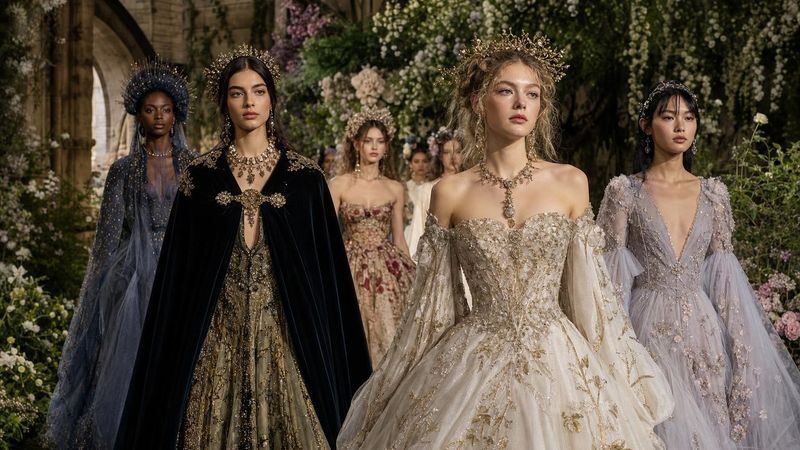
You do not have to squint at the runways to see it anymore. Between Chanel’s carved heels that climb like “Jack and the Beanstalk,” Simone Rocha’s lace gowns inspired by Irish legends, and Robert Wun’s rainbow look crowned with a medieval hennin hat, fashion has slipped into a full-on fairy-tale era. On social feeds, princesscore, fairycore, and “everyday whimsy” sit right next to haute couture clips in your explore tab.
For models and image-makers, this is more than a pretty mood. The current fairy-tale fashion trend is changing what casting directors ask for, how clothes move on the body, and the kind of storytelling expected in editorials and campaigns. If you want to book into this wave instead of just liking it on Instagram, it helps to understand the mechanics behind the magic.
From weird medieval to full-on fairy-tale: why fashion is escaping into fantasy
The shift did not come out of nowhere. In late 2025, the “weird medieval” aesthetic started circling runways and TikTok: pointed hennin hats, distressed brocades, long gloves, heavy jewelry that looked dug up from a castle floor. That mood collided with a darker, girlier “dark coquette” energy, producing embroidered cloaks, puffed sleeves, and grand ballgowns that felt halfway between a Renaissance painting and a goth romance novel.
By fall 2026, the references turned explicit. Chanel’s couture show used nursery stories as a blueprint, down to animal-shaped buttons that recalled “Goldilocks and the Three Bears.” Simone Rocha wove Enbarr and Tír na nÓg from Irish folklore into sheer, ribboned gowns. Robert Wun cited Hayao Miyazaki, sending out dreamlike characters that could have walked out of an animated film. At Jean Paul Gaultier, guest designer Duran Lantink tied floor-grazing black bows to the back of models’ heads so they trailed like ink across the runway. Viktor & Rolf’s “Gilded Age 2.0” went further, turning two models into living symbols: one in stiff, gilded excess, the other in rough burlap, dressed and undressed live to contrast opulence with the labor that underpins it.
It is not the first time fashion has run toward fantasy during turbulent periods. Just over a century ago, the Surrealists tried to merge dream and reality in response to the trauma of World War I. Writer André Breton called it a search for “an absolute reality, a surreality” in his 1924 Surrealist Manifesto. Today’s fairy-tale mood works in a similar way: when news cycles feel relentless, whimsy becomes a coping strategy. One major newspaper even described whimsy as a “life raft” for Zillennials. For models, that cultural backdrop matters because it explains why designers now want you to look less like a blank canvas and more like a living character.
How the fairy-tale fashion trend changes casting and model performance
In a fairy-tale season, a casting brief reads differently. Instead of “cool, clean, minimal,” you might see lines about a “restless heroine,” “enchanted outsider,” or “noble but dangerous queen.” Mood boards mix film stills from Miyazaki with Celtic myths, Disney screenshots, and vintage storybook covers. Collections like Simone Rocha’s folklore-inspired fall show or Robert Wun’s anime-tinged looks give casting teams permission to think in roles, not just measurements.
That means expressiveness has gone up in value. Directors look for eyes that can flick from innocence to mischief, faces that hold stillness without going flat, and body language that hints at a backstory. Distinctive features can become an asset: a sharp profile for a fairy-tale villain, a strong jaw for a knight archetype, silver hair or visible lines for a modern crone or oracle. Agencies are increasingly asked for short videos where models walk “in character” or cycle through emotions, not just basic digitals.
Performance does not stop at the end of the runway, either. On the The Odyssey press tour, Zendaya floated through premieres in angelic Matières Fécales looks while Lupita Nyong’o chose dramatic, regal gowns; both used method-style dressing to turn red carpets into mythology. When brands book models for events now, they may expect a similar commitment: staying in the mood of the collection during step-and-repeats, interviews, or social content.
Technically, the clothes themselves demand more from the body. Fairy-tale silhouettes often mean heavy skirts, long trains, constricting corsets, or fantastical shoes with carved heels. Those extreme bows from Duran Lantink’s Jean Paul Gaultier outing? They require precise awareness of what is trailing behind you. Walks are usually slower, turns are controlled, and posture has to be strong enough that the garment looks effortless, not overwhelming. On set, poses may need to be adapted so a sculptural sleeve or cloak can still read in the frame without swallowing your shape.
Editorial fantasy and career strategy in fashion’s storybook era
Editorially, fairy-tale fashion is less about a single dress and more about a full narrative arc. A shoot might be pitched as “the girl who wandered into an endless forest” or “the prince who refuses the crown,” then broken into scenes: the moment before the spell, the height of the curse, the transformation. References are pulled from everywhere: old French folktale collections like Les Fées, Contes des Contes rumored from Gabrielle Chanel’s library, TikTok fairycore mood boards, or even the visual language of classic Surrealist paintings.
For the model, that means reading the treatment closely and asking where your character is emotionally in each setup. Early frames may call for suspicion, tension in the shoulders, or inward-turned feet; later images might need expansive gestures and confident eye contact. Props – a lantern, a cloak, a branch, a jeweled shoe – should feel like extensions of your body, not awkward add-ons. Location does a lot of the work (a mossy forest, baroque ballroom, or empty parking structure lit to look uncanny), but your micro-expressions close the loop between fashion and fable.
From a career point of view, you do not have to turn your entire book into a Grimm anthology to tap into the moment. One or two well-executed, storybook-leaning editorials or tests can signal that you can handle volume, props, and a strong mood. Think: a tulle dress and combat boots in a bleak industrial space, or a cape thrown over simple tailoring on a rooftop at dusk. The rest of your portfolio should still include clean beauty, denim, and modern tailoring so clients can picture you outside the fantasy too.
On social media, sprinkling in elements of everyday whimsy – long ribbons, glittering court shoes, romantic headpieces – can connect you with the fairy-tale wave without slipping into full cosplay. Keep hair and makeup polished, avoid replica costumes, and tag the creative teams so the content reads as editorial, not costume-party. Behind the scenes, skills like basic acting, movement coaching, and simply practicing walks in long skirts or with elaborate headpieces will continue to pay off even after this particular trend cools. Fairy-tale fashion might fade into the next big “core,” but the ability to inhabit a character, tell a story, and move intelligently in challenging clothes will stay on every casting director’s wish list – happily ever after or not.