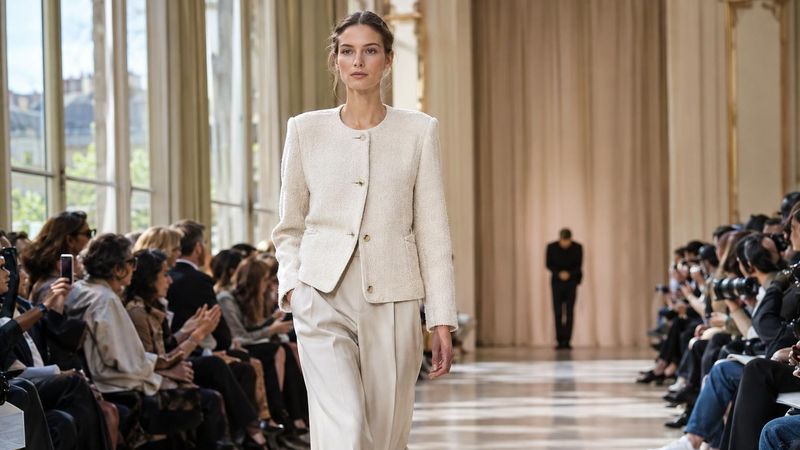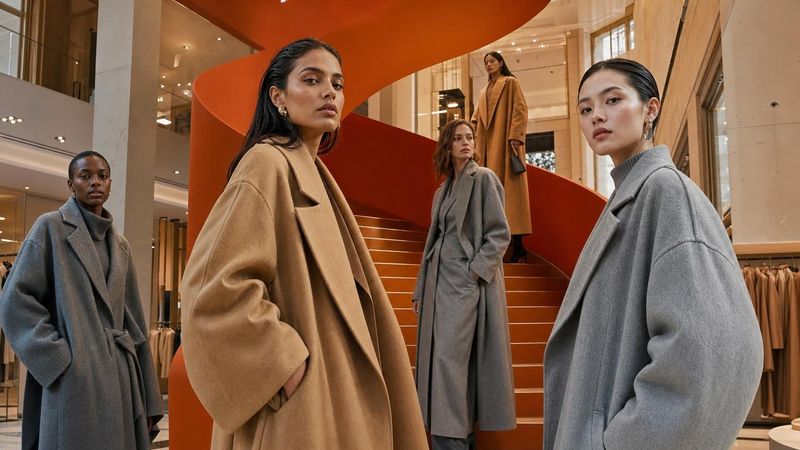
Max Mara quietly shifted the conversation around power dressing this season, bringing its Max Mara Atelier Fall 2026 Ready-to-Wear collection to Paris during Haute Couture Week and installing it inside the brand’s revamped Avenue Montaigne flagship. Instead of a theatrically staged runway, guests moved through a space designed like a working studio, surrounded by coats that looked ready not for the red carpet, but for a boardroom on a cold Monday morning.
The message was clear. Atelier is where Max Mara refines its coat obsession to couture-level precision, while keeping the clothes resolutely wearable. The way the house tailored, presented and cast this collection underlined something industry insiders already know. At this level, a coat is not just a purchase or a picture. It is a relationship – between the brand and its clients, and between the brand and the models it chooses to embody that quietly powerful woman.
Max Mara Atelier Fall 2026: Architectural Coats for Quiet Power
Fashion director Laura Lusuardi summed up the line with a simple statement: “For us, Atelier is the couture of Max Mara.” Fall 2026 takes that idea literally, under the banner “The Architecture of a Coat.” The design team looked back to Max Mara’s Bauhaus-influenced factory in Reggio Emilia, built in 1959, and to a lineage of women architects including Gae Aulenti, Eileen Gray, Cini Boeri, Florence Knoll and Sophie Hicks. “A coat is architecture,” Lusuardi said. “It has to be functional, but at the same time beautiful.” The result reads like industrial couture, where form genuinely follows function.
Monsieur coats, razor-sharp redingotes, sculptural capes and kimono-wrapped shapes balanced generous volume with clean, vertical lines. Cashmere, tweed, radzimir and faille gave those structures a tactile warmth, so the rigor never felt severe. The palette moved from concrete, asphalt and charcoal greys into brick, burgundy, Klein blue, deep chocolate and controlled flashes of gold. On the body, these look like real tools of power dressing: coats that frame the shoulders, protect the wearer from the elements and the city, and signal authority without a single logo in sight.
Inside the Avenue Montaigne Presentation and Casting Strategy
The show unfolded inside Max Mara’s 31 Avenue Montaigne flagship, redesigned by Sophie Hicks, whose bright orange helical staircase coils through the space like a three-dimensional logo. Presenting a ready-to-wear collection during Paris Haute Couture Week, and doing it in a retail environment, positioned Atelier as the peak of the brand’s coat-making while keeping it close to the point of sale. Around the racks, visitors could trace the making of a coat from sketch to pattern to toile, with a vintage Japanese kimono from the archive and obi-style belt details linking East Asian craft to Italian tailoring. A thin line of red basting thread running through pieces nodded to the sewing school founded by Achille Maramotti’s mother, making heritage part of the design language rather than a slogan.
This kind of intimate presentation naturally shifts attention to faces and bodies as much as to clothes. Instead of a cast built for viral runway clips, Atelier favors models who read as believable clients: grown-up, self-possessed, with an ease in tailored layers. The styling tends to reinforce that – hair that could survive a workday, makeup that looks like good skin rather than a concept. For agencies and models, being booked for Max Mara Atelier alongside the main line signals trust and longevity. Brands that build on this kind of consistent, realistic casting create a roster of women audiences recognize from season to season, which quietly reinforces the idea that these coats belong in a stable, long-term wardrobe.
Long-Term Power Dressing and Relationship Luxury
Lusuardi likes to say that “behind every coat there is always a creative idea,” but the Fall 2026 Atelier pieces are also built around a lifecycle. They are sold as private luxury, often in conversation with a trusted sales associate or stylist, and meant to live with a client for years. The architectural construction and rationalist proportions are there so the coat can sit over different silhouettes as careers and routines evolve, from early-morning commute to late board meeting. In that sense, the collection is less about novelty and more about giving the wearer a structural constant in her professional life.
For luxury watchers, Max Mara Atelier Fall 2026 Ready-to-Wear shows where power dressing is heading. Logos and spectacle matter less than cut, cloth and credibility. A flagship presentation during couture week that doubles as a working showroom, a casting that feels continuous with the clientele, and coats that function as long-term infrastructure in a wardrobe all point in the same direction. The future of this segment of fashion looks a lot like these architectural coats in motion: quiet, precise and built on relationships that last longer than a season.