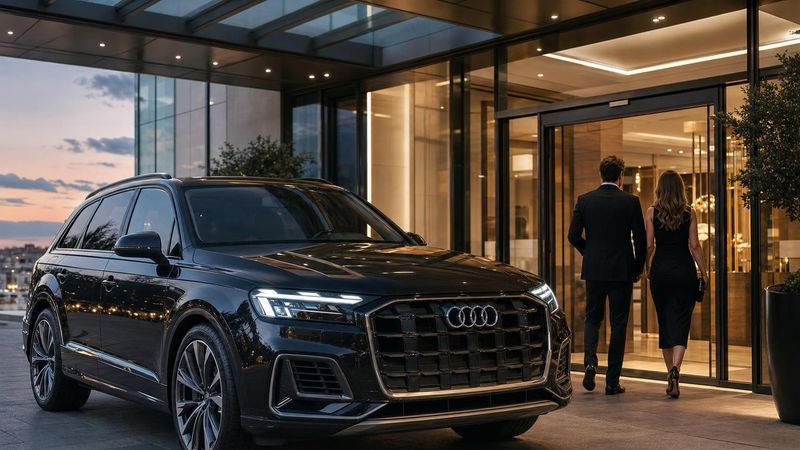
Audi’s new Q9 isn’t just another big SUV. It’s the brand’s largest vehicle ever, a full-size three-row flagship designed as much as a lounge as a car. For the fashion and modeling world, that matters, because the way a product is built quietly dictates the way it will be advertised.
Everything about the Q9 signals a shift from “driver’s car” to “mobile living space” for high‑net‑worth families and executives, especially in the U.S. and Middle East. That shift opens a very different kind of premium car campaign: less about cornering speeds, more about people, atmosphere, and styled lives in motion. In other words, the kind of environment where established faces and auto–luxury crossover models can carry the story.
Audi Q9: a flagship SUV made for lifestyle storytelling
The Q9 sits above the Q7 as Audi’s first true full‑size SUV: around 5.3 meters long, with a wheelbase of more than 3.1 meters and three rows of seating for six or seven people. It goes straight at the BMW X7, Mercedes‑Benz GLS, Cadillac Escalade, Range Rover, Lexus TX, and Lincoln Navigator, with U.S. pricing expected in the roughly 90,000 to 120,000 dollar band for Q9 and SQ9.
Instead of selling itself only on power figures, the Q9 leans hard into comfort and presence. Six‑seat versions swap the middle bench for plush captain’s chairs with full electric adjustment, heating, ventilation, and a layout that feels closer to business‑class air travel than traditional SUV back seats. The third row is genuinely adult‑friendly, which makes ensemble casting and multi‑generation storytelling much more believable on camera.
Inside, Audi moves away from glossy piano black to open‑pore wood, brushed metals, textured surfaces, and even alpaca upholstery options in some trims. A wide curved screen spans the driver and central infotainment area, with a dedicated display for the front passenger. Visually, it all reads like a high‑end hotel lobby or first‑class lounge: layered light, soft materials, and tech that wants to disappear into the background. That’s exactly the kind of environment where a fashion editorial could unfold without feeling forced.
From spec sheet to creative brief: how the Q9 shapes its own launch ads
For years, luxury SUV advertising relied on aerial road shots, slow‑motion off‑ramps, and the lone driver conquering a mountain pass. The Q9’s product brief points somewhere else. Its selling points are in‑cabin: automatic doors that open to 90 degrees, a vast panoramic roof, selectable ambient lighting, and hands‑free highway driving assistance that lets occupants settle into work, rest, or conversation.
The panoramic sunroof is arguably the hero feature from a visual standpoint. It’s the largest ever fitted to an Audi SUV, covering over 1.5 square meters, with optional switchable transparency that can go from clear to opaque at the touch of a button. Pair that with ambient lighting strips that follow the color mood you set, and the car becomes its own light box. Directors and photographers get built‑in backlight for silhouettes, moody night interiors in deep jewel tones, and golden‑hour overhead light without extra rigs.
On the outside, Digital Matrix LED headlights and ultra‑thin OLED rear lights create a very graphic lighting signature. The rear units curve around the body, and optional turn indicators can literally project a directional motif onto the road. Add the automatic doors with obstacle detection and soft‑close, and you have a natural red‑carpet moment every time someone steps in or out. Launch films can lean into those slow, composed entrances and exits, where the talent’s styling is just as important as the car’s sheet metal.
Why full‑size luxury SUVs tend to favor established faces
The typical buyer for a 90,000 dollar‑plus flagship SUV is not experimenting. They’re buying reassurance, status, and the feeling that they are making a considered, adult choice. That psychology tends to push launch advertising toward recognisable, trustworthy faces rather than unknown newcomers, especially in the first campaign cycle.
Rival models in this space have already paved the way: the X7, GLS, Escalade, and Range Rover have all leaned on actors, musicians, or long‑running fashion talent to embody “global executive”, “creative leader”, or “modern family” archetypes. The Q9 enters a visual landscape where big faces are expected, but Audi’s more understated design language leaves room for a different type of presence: calmer, less showy, more design‑literate.
For casting, that suggests a few clear lanes. One is the dual‑career couple in their late 30s to 50s who look at home in both a boardroom and an art fair. Another is a multi‑generation family where grandparents, parents, and children all feel contemporary and international rather than cliché. A third is the creative entrepreneur or founder whose wardrobe bridges streetwear, tailoring, and tech. For Gulf markets, group scenes that communicate hospitality, friendship, and understated opulence will matter. Across all of them, the sweet spot is established talent: models and actors with an existing body of premium work, the ability to carry close‑ups, and a believable relationship to wealth and discretion.
New room for auto–luxury crossover models and collaborations
The Q9’s positioning makes it a natural anchor for collaborations between automotive, fashion, and lifestyle brands. Full‑size SUVs are already the default fleets for fashion weeks and film festivals; a cabin this deliberately “lounge‑like” invites deeper integration than just logo decals on doors.
Interior materials and tech open specific crossover opportunities. Alpaca throws, cashmere blankets, travel pillows, leather trays, and tech pouches can all be co‑designed with houses in fashion, luggage, or homeware to live inside the Q9 in campaign imagery. Ambient lighting tied to a brand’s color story, or a panoramic roof glowing in a signature hue, effectively turns the car into a moving pop‑up installation.
For models, this shift means that “in the car” imagery stops being filler and becomes central. Portfolios that show relaxed but polished moments in transit, working on a laptop, touching up beauty in reflective glass, or interacting with high‑end tech will read as directly relevant to an Audi Q9‑type brief. The most convincing auto–luxury crossover faces will be the ones who can inhabit that mobile living room naturally: unbothered by cameras, wardrobe sitting comfortably in deep seats, body language quiet but confident.
How agencies and talent can prepare for Audi Q9‑era briefings
Creative agencies pitching on premium car campaigns can treat the Q9 as a signal of where the segment is heading. Moodboards built around “salon on wheels”, “private lounge in motion”, and “family office on the road” will feel closer to the product truth than traditional performance‑only stories. Visually, that means framing the car as architecture as much as object: wide interior shots that show depth, layered reflections in glass, and lighting that evolves through a journey.
Established models and actors who see themselves in this space can make small but concrete portfolio tweaks. Shots in chauffeured settings rather than behind the wheel, styling that mixes tailoring with travel pieces, and scenes that suggest arrivals at galleries, hotels, or private terminals all help art directors imagine them in a Q9 role. For influencers, long‑form content that takes followers “between” destinations in a calm, design‑driven way will be more aligned than high‑energy driving reels.
The Q9’s launch advertising will come and go, but the template it sets is likely to stick: big SUVs sold as quiet, rolling living rooms, told through faces we already trust and collaborations that blur the line between car, fashion, and home. For anyone working in premium campaigns, that’s a space worth preparing for now.