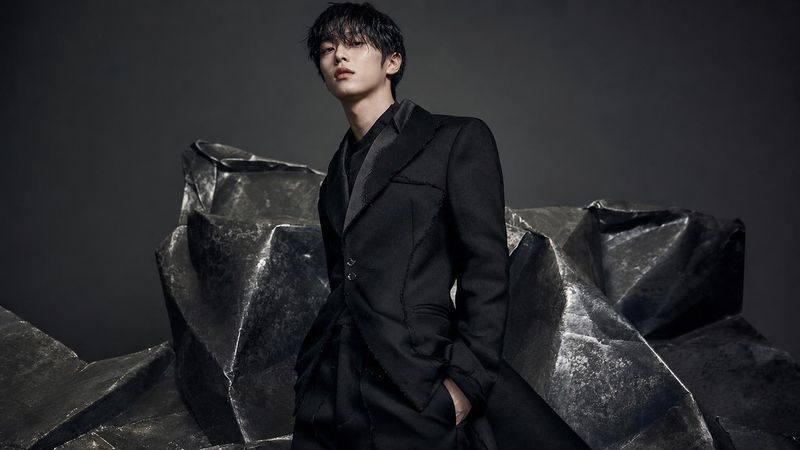
In Songzio’s Fall Winter 2026 images, Park Seonghwa of ATEEZ stands almost statuesque, half carved out of light, half absorbed by deep shadow. The tailoring around him looks as if it has been crushed, twisted, then rebuilt: frock coats warped at the hem, three‑piece suits stretched into new volumes, high collars slicing through the dark. This is the campaign the Korean house titles “Crushed. Cast. Constructed.” – and it places a K‑pop performer, not a traditional model, at the center of a very conceptual menswear story.
Under creative director Jay Songzio and photographer Daniel Archer, the campaign pushes Seonghwa’s role beyond simple celebrity cameo. He is already the brand’s global ambassador; here, his controlled, dancer’s physicality becomes the tool that makes an industrial, Machine Age narrative readable. That choice quietly captures a bigger shift: K‑pop stars are no longer just invited to sit front row or push logo accessories. They are being trusted to carry directional menswear, the kind of work that once went only to anonymous editorial faces.
From one runway invite to full house face
The Songzio × Seonghwa story started on the runway. Seonghwa first stepped into the brand’s world during the Spring Summer 2026 “Polyptych” presentation at Paris Fashion Week, walking in a collection built around fragmented time and shifting identities. Shortly after, the house formalized the relationship by naming him global ambassador, turning a single show slot into a long‑term casting strategy rather than a fan‑service moment.
That status quickly translated into imagery. Seonghwa fronted the Fall Winter 2025 “Piccadill” campaign, photographed by Kim Hee June, aligning his face with Songzio’s sharp, art‑driven tailoring. In January 2026 he returned to Paris for the Fall Winter 2026 “Crushed. Cast. Constructed.” runway show, then moved straight into the campaign itself with Archer. Across these seasons, he stops reading as “idol guest model” and starts to look like the house’s primary menswear protagonist, with each chapter layering onto the last.
“Crushed. Cast. Constructed.”: industrial pressure, performed
For Fall Winter 2026, Songzio turns back to the turn of the 20th century and the violent arrival of the Machine Age. The collection examines how mechanical force reshaped material, labor, and even the human body, filtered through the label’s ongoing “Order Disorder” philosophy. Pressure, damage, and reconstruction are treated as stages in design: garments are pushed to the point of distortion, then re‑stabilized into something new.
That thinking shows up in the clothes and in how they are shot. Classic menswear foundations – frock coats, tailored three‑piece suits, high‑collared shirts – are torqued and twisted so their silhouettes hold visible tension, echoing the crushed metal sculptures of artist John Chamberlain. Archer uses concentrated beams of light and deep shadow to slice across Seonghwa’s frame, catching folds, stress lines, and sudden volumes. Glossy surfaces snap back highlights; matte fabrics sink into darkness. The set is stripped of distraction so the only real conversation is between Seonghwa’s body and the tailoring, his precise stillness making the idea of “controlled damage” feel physical rather than purely abstract.
Why K‑pop idols are fronting the most conceptual menswear
A decade ago, campaigns like this would almost certainly have featured an unknown but highly “editorial” model: angular features, long limbs, little public story attached. Songzio’s decision to place a globally recognized idol at the center of such a dense concept reflects how the economics of casting have changed. Luxury and directional brands now measure the value of a face not just in print pages, but in earned media value – the reach and engagement that talent can generate across social platforms and press.
ATEEZ offers a clear example of why this matters. Group member San, for instance, has been credited with driving several million dollars’ worth of estimated earned media value in recent seasons as a global ambassador for Dolce & Gabbana, simply by wearing the brand on and off the runway and amplifying it to a highly mobilized fanbase. When a single K‑pop member can move that kind of attention, even avant‑garde houses take notice. For Songzio, anchoring a Machine Age, industrially torqued collection on Seonghwa means the story lands simultaneously in Paris menswear reviews and inside a global fandom used to decoding his performances frame by frame.
What this shift means for models and aspiring talent
For working and aspiring models, the Seonghwa example underlines how the job description at the top of directional menswear is evolving. Image alone is no longer enough; brands increasingly look for performers who can inhabit a narrative across runway and campaign, season after season. Seonghwa’s training as a singer and dancer – his ability to hold tension in stillness, to change a character with a small shift in gaze or jawline – allows a photographer like Archer to shoot more severe, minimal frames without losing emotion.
That does not mean every campaign will go to pop idols, but it does raise the bar on what “presence” looks like. Performance classes, movement coaching, and even basic stage experience can set a model apart when a casting director needs someone who can communicate concepts like fragmentation, pressure, or reconstruction without dialogue. For stylists and casting teams, Songzio’s multi‑season commitment to Seonghwa is a case study in treating talent as a co‑author of the brand universe: the same face travels from the fractured timelines of “Polyptych” into the compressed metal world of “Crushed. Cast. Constructed.,” making the house’s visual language feel continuous rather than reset every six months. That continuity is where directional menswear casting is quietly heading – and K‑pop’s star system is accelerating the shift.