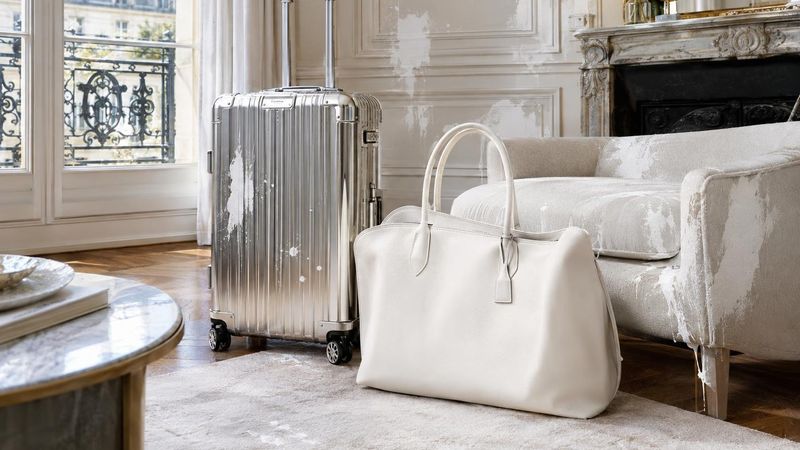
Rimowa and Maison Margiela have hand-painted a suitcase and a handbag so they look better as they get beaten up. The limited-edition collaboration, titled Wear, Tear and Patina, pairs Rimowa’s aluminum Classic Cabin with Maison Margiela’s 5AC XL leather bag, both finished in the Paris house’s Bianchetto overpainting technique. Both land in stores on November 19, 2026.
Prices sit at roughly 3,200 euros for the cabin case and 3,600 euros for the bag, sold through selected Rimowa and Maison Margiela boutiques and both brands’ online stores, with US pricing following local market rates. For an industry that treats airport corridors as an extension of the runway, this is fashion-house design logic applied to travel hardware, promoted by an object-led campaign that leaves models out of the frame entirely.
Why the Rimowa x Maison Margiela Tie-Up Stands Out
Rimowa, owned by LVMH since 2017, has spent a decade lending its grooved aluminum shell to logo-forward partners, among them Supreme, Dior, Tiffany and Co., Off-White, Moncler and Fendi. The Margiela project reads differently. Instead of a monogram or a graphic print, it sells an idea about aging and imperfection, which is harder to photograph and more interesting to style.
Bianchetto is the engine of that idea. The technique dates to 1988, when Belgian founder Martin Margiela painted the furniture in his Paris studio white, to disguise the mismatched pieces and let time finish the job. Every case and bag here is hand-painted, and the coating is meant to crack, chip and flake with use. According to the two houses, the process is “rendering them as unique records of lived experience, transforming with time.”
Inside the Design: Grooves, Linings and a Bag That Docks
Rimowa’s aluminum grooves, introduced in 1950 and inspired by aircraft fuselage construction, carry across both pieces. On the 5AC XL they are formed directly into the leather using a high-frequency technique that requires no stitching, and removable leather loops let the bag attach to the suitcase’s telescopic handle with the lines aligned. A removable cross-body strap keeps it wearable on its own.
The Classic Cabin keeps its practical core: Multiwheel system, TSA-approved locks, telescopic handle. The interior is where the fashion house takes over, with an all-white lining, exposed stitching and overlocked edges that make the case resemble a garment turned inside out. The aluminum logo badge is held by the house’s signature four white stitches, and both pieces carry a double leather tag combining Rimowa’s address label with Margiela’s key bell.
What an Object-Led Campaign Says About Casting
The campaign, directed and photographed by Dexter Lander, stages the pieces in a Haussmannian Paris apartment as if white paint had exploded across the rooms. Suitcase and bag appear as clean silhouettes against upholstery and wallpaper, negative space doing work a model would normally do. No talent is credited, which fits Maison Margiela’s habit of obscuring faces and letting process carry the image.
For models and the people who cast them, the choice is worth noting. Luxury travel campaigns have leaned on character-driven casting lately, but this one skips the human element and treats the product as protagonist. That leaves a template for airport editorials and fashion-week behind-the-scenes coverage, where luggage often reads as part of a character’s styling rather than a prop.
The aesthetic is easy to translate: monochrome white, cream or grey airport looks that let the chalky finish stand out, or sharp black tailoring for contrast. Travelers not spending 3,200 euros can nod to the same idea with a scuffed white leather weekender or a visibly repaired case. The collection lands November 19, 2026, in limited quantities.