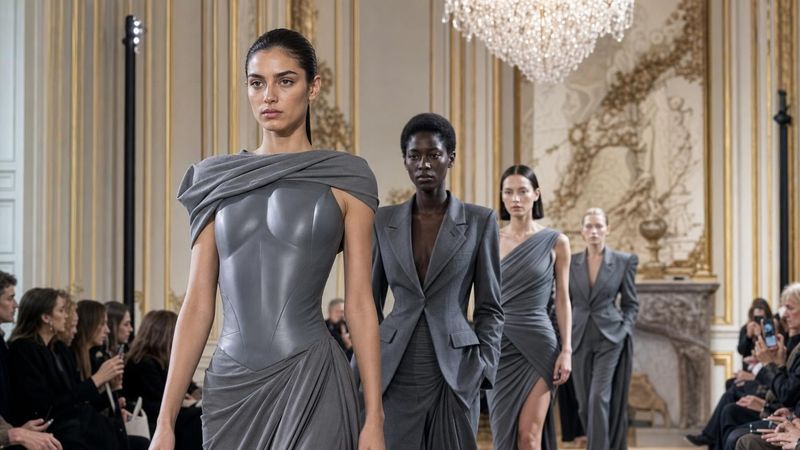
On July 6, 2026, at 6:30 p.m. in Paris, a small Irish-led atelier quietly stepped into fashion’s highest arena. Inside the Irish Embassy, Standing Ground unveiled its Fall 2026 couture collection, marking designer Michael Stewart’s first show on the official Fédération de la Haute Couture et de la Mode schedule.
Listed as a guest house on the Fall/Winter 2026–2027 haute couture calendar, Standing Ground joins a group of fewer than thirty labels worldwide allowed to use that designation. The debut came as an ultra-edited eight-look presentation that stayed true to Stewart’s sculptural, custom-only vision, raising the question of how a brand this small can hold its own alongside the grand maisons without sacrificing its pace.
From County Clare to the official couture calendar
Michael Stewart grew up in County Clare, Ireland, and refined his eye at London’s Royal College of Art, where he graduated in 2017. His work first caught industry attention through Fashion East, the influential London incubator that hosted Standing Ground on its runways in 2022 and 2023. Those early shows already carried his now-recognizable language of controlled draping, clean columns and references to Greek and Roman statuary.
Industry validation escalated quickly. Stewart received the LVMH Prize Savoir-Faire Award in 2024, a nod that specifically recognizes technical excellence and craft. From a compact studio at 180 Strand in London, he has built Standing Ground as a made-to-measure operation: no wholesale, no boutiques, almost entirely custom order. That slow-build approach makes his arrival as a guest house at Paris Haute Couture Week feel less like a pivot and more like formal recognition of a practice that has always worked at couture level.
Inside Standing Ground Fall 2026 couture’s eight looks
The setting at the Irish Embassy framed the show as a conversation between heritage and high craft. The collection opened in somber grey tailoring: a sharp jacket over a bias-cut silk skirt, edges traced with Stewart’s signature technique of tiny beads sitting under a sheer layer of fabric. It set the tone for a lineup that favored precision over spectacle.
From there, the silhouettes moved into the territory that Standing Ground watchers will recognize. Meticulously draped jersey gowns clung and fell in clean vertical lines, their surfaces broken by tonal hand-beading that read almost like topography. Column dresses introduced perforated, grid-like panels that revealed skin in measured slivers, echoing the carved voids of classical sculpture rather than trending cut-outs.
The final exits pushed the ancient references forward in time. Molded breastplates, with a chalky, weathered finish, were layered over heavy, pooled drapery, giving the impression of statues mid-excavation. The mood landed somewhere between archaeological find and quiet sci-fi, consistent with Stewart’s interest in forms that feel both primal and futuristic. With just eight looks on the runway – the same concise edit that appears on Vogue Runway – every exit worked like a thesis statement on stillness, surface and line.
Casting, runway message, and what it signals for models
If the clothes argued for restraint, the casting underlined the label’s fashion-insider pull. Ivy Stewart opened the show, setting a focused, unhurried pace, while icon Kristen McMenamy closed – a deliberate choice that connects Standing Ground to a lineage of cerebral, image-driven fashion. Between them walked editorial fixtures like Saskia de Brauw, Yilan Hua, Yumi Lambert, Rejoice Chuol and Felice Nova Noordhoff, creating an intergenerational cast that spanned established muses and current campaign faces.
The line-up came together under casting director Piergiorgio Del Moro, with styling by Tallulah Harlech. Hair by Duffy and makeup by Daniel Sällström kept the models’ faces and silhouettes clean, letting the sculpted garments sit front and center, while Michel Gaubert’s sound design and Emma Chadwick’s movement direction reinforced the show’s measured, almost ritual pacing. For a debuting guest house, assembling this level of team signals serious backing and a clear intention to speak to high-fashion editors, not just private clients.
For aspiring models watching from afar, a show like Standing Ground’s Fall 2026 couture debut hints at what this tier of runway work demands. Portfolios that lean editorial rather than commercial, comfort with slower, pared-back walk styles, and the ability to wear highly structured, body-conscious pieces without overpowering them are all part of the equation. When a young couture house works with top casting and keeps its cast tight, every model is essentially a lead – a high-pressure, high-visibility situation that can be career-defining.
For Michael Stewart, the Irish Embassy presentation formalizes Standing Ground’s place inside the couture ecosystem while keeping its promise of scarcity intact. For models and fashion-watchers, Standing Ground Fall 2026 couture reads as a signal that the next wave of couture will not necessarily be bigger or louder, but sharper, more controlled and intensely focused on the body as sculpture.