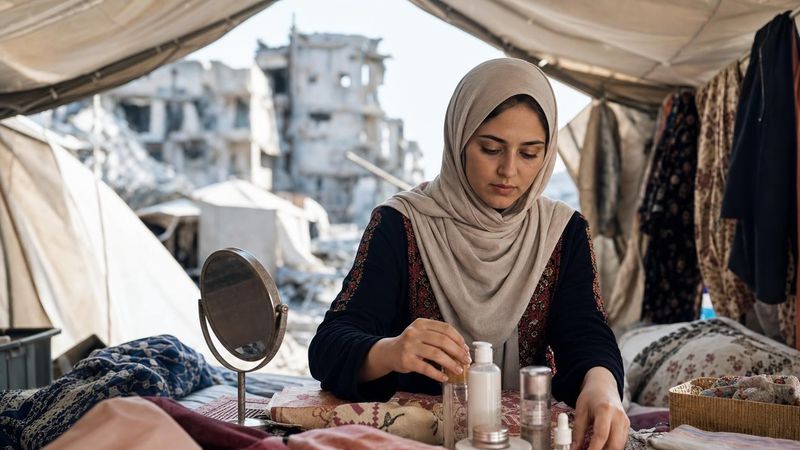
In a plastic tent pitched on a muddy patch of ground in Gaza, a woman smooths a thin layer of cream over her face, using a shard of broken mirror as her compact. Outside, generators hum and drones buzz overhead. Inside, for a few minutes, the focus narrows to skin, breath and the familiar ritual of getting ready.
For many women in Gaza, these moments of care are happening in the middle of bombardment, displacement and chronic shortages. Skincare routines, makeshift salons and neatly arranged corners of a tent are not about chasing trends; they are about holding on to dignity and a sense of self when almost everything else has been stripped away.
As one Gazan skincare specialist, Dr Sana’a Kabariti, puts it, “We lost everything, but we won’t lose our beauty.” Her words capture a quiet, insistent refusal: even when basic healthcare collapses, women are still finding ways to look after their bodies and appearance.
When basic care disappears: women’s bodies under siege
Since late 2023, repeated airstrikes and a tight blockade have devastated Gaza’s infrastructure. United Nations agencies report that a large majority of the population has been displaced, often multiple times, forced into overcrowded shelters or tents with little privacy. In the first months of the war, two thirds of more than 11,000 reported Palestinian deaths were women and children, according to Gaza’s health authorities and UN summaries, underlining how directly this violence hits female bodies and lives.
The health system that used to support those bodies has largely collapsed. UN agencies and medical NGOs describe more than half of Gaza’s health facilities as damaged or out of service. Around 50,000 pregnant women have had to navigate pregnancy, birth and post-partum without reliable access to clean water, electricity or pain relief. Neonatal units that still function are running at up to 150–170% of their capacity, with incubators sometimes shared by three newborns and single-use supplies being reused because there is no alternative.
Everyday hygiene has turned into a daily negotiation. With treated water production at a fraction of pre-war levels, many women cannot shower regularly, wash their hair or launder clothes as they once did. Access to menstrual products is limited; some have resorted to taking hormonal pills to delay their periods because they cannot manage bleeding safely in crowded shelters with few toilets and little water. Human rights organizations have warned of rising risks of infections like hepatitis B and vaginal candidiasis. Layered on top is widespread malnutrition, especially among pregnant and breastfeeding women, who present with anemia, extreme fatigue, hair loss and changes in skin tone.
Tent clinics and rubble salons: self-care in impossible conditions
Caught in this emergency, Dr Sana’a Kabariti chose to return to her original passion: skincare. Trained first as a pharmacist, she later specialized in dermatological aesthetics, taking multiple courses and teaching other healthcare workers. Displaced early in the war and then again and again, she eventually set up a small “clinic” under canvas in Rafah, offering free or low-cost consultations to women who showed up with sunburned, inflamed and exhausted skin.
She describes patients who have walked long distances in blazing sun after each new evacuation order, often without sunscreen or hats, then lived for months in tents that do little to block UV rays. Prolonged exposure, combined with stress and poor nutrition, has led to widespread hyperpigmentation, facial melasma, dark circles, extreme dryness and breakouts linked to sweat, dust and polluted air. With professional products hard to find and prices soaring, Dr Kabariti improvises with whatever gentle cleansers, emollients and prescription creams she can still source, explaining basic routines that can be followed even with very little water.
Other women have opened spaces that sit somewhere between a beauty studio and a community center. In one heavily damaged Gaza neighborhood, a young hairdresser set up a salon inside a tent pitched amid rubble, with a salvaged mirror, a chair and a small table of tools. Clients arrive from nearby camps to have their eyebrows threaded, hair trimmed or styled, or a hint of henna applied. They talk, cry, compare notes on aid distributions and, for an hour, see a reflection that feels closer to who they were before the war. The prices are symbolic; the impact is not.
Micro-rituals of order: when organizing a tent is self-care
Self-care in Gaza does not always look like a clinical treatment or a salon visit. For content creator Shams Abdeen, it starts with a blanket, a plastic shelf and a small bottle of musk. She married on October 6, 2023, with plans to decorate a new apartment; the following day, the war began. Displaced to a tent, she began documenting how she organizes that tiny space: lining up her skincare and makeup, folding clothes into careful stacks, hanging scarves in coordinated colors, planting mint in plastic tubs outside the entrance.
In her videos, Abdeen applies a dab of perfume to her wrists, sweeps sand from the floor and rearranges cushions until the tent looks as inviting as possible. She has spoken about sinking into deep depression and turning to these routines as a way to cope when her studies were suspended and she felt she had no control over anything beyond a few square meters of canvas. “Just because I’m organizing doesn’t mean I’m okay,” she explains, but the act helps her thoughts feel less chaotic.
Research on other displaced communities supports what women like Abdeen describe. A 2021 study on Syrian refugee women in Lebanon found that those who participated in gardening projects reported significantly lower levels of depression. The simple act of nurturing plants and beautifying a harsh environment offered emotional relief. In Gaza’s tents, arranging beauty products, straightening a sleeping mat or decorating a corner with green leaves plays a similar role: it restores a sense of agency and reintroduces aesthetic pleasure into surroundings defined by threat.
Beauty, dignity and mental health
Psychologists working with women in conflict zones often emphasize the grounding power of bodily routines. In Gaza, local counseling centers and NGOs weave grooming and hygiene back into trauma support whenever possible, distributing “dignity kits” that include soap, shampoo and menstrual products alongside food and medicine. Being able to wash your hair, change into a clean dress or put on a favorite lipstick for a camp wedding can ease anxiety in ways that are hard to quantify but easy to recognize.
Philosophers of aesthetics have argued that beauty is not a superficial extra but part of what makes life feel worth living. In Gaza, that idea becomes very concrete. When a woman sits in a tent salon to have her hair braided, when she smooths a bit of moisturizer over sunburned cheeks, or when she chooses the brightest scarf she owns before queuing for aid, she is asserting: I am still here, still visible, still myself. In a context where women’s reproductive health, privacy and even ability to bathe are under attack, these gestures are quietly radical.
What a global beauty community can do
For readers immersed in fashion and beauty content, the contrast can be jarring: glossy campaigns and runway looks on one screen, tent salons and water-rationed routines on another. It is tempting to scroll past or to romanticize the resilience on display. A more useful response starts with paying attention to the women telling their own stories from Gaza, amplifying their voices rather than speaking for them.
Beyond that, the most practical support often comes through organizations already on the ground: groups that repair maternity wards, fund mobile clinics, provide psychological support and distribute hygiene and dignity kits to displaced women. Following and backing such initiatives connects the language of self-care that dominates much Western beauty culture with the far more literal struggle for care in places like Gaza.
The next time you line up serums on a bathroom shelf or get ready backstage at a show, it is worth holding both realities in mind. For many women, beauty is a career, a hobby or a source of pleasure. For women in Gaza, it has also become a fragile but vital way to protect their sense of humanity when everything around them is designed to erase it.