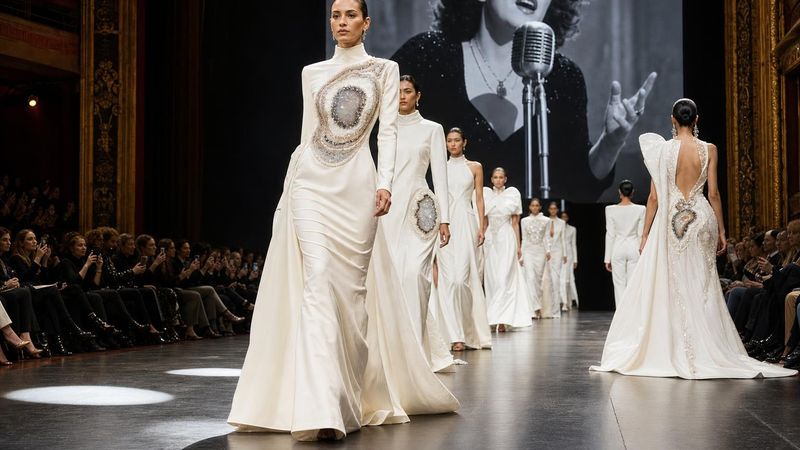
On July 7, 2026, during Paris Haute Couture Week, Stéphane Rolland turned L’Olympia into a couture stage for his Stéphane Rolland couture automne 2026 show honoring Dalida. Marking forty years since the singer’s death, the couturier took her Cairo to Paris story and her legendary concerts in this theater as the backbone of 33 looks. Instead of retro pastiche, he offered a clean, mineral take on Mediterranean glamour. For the models, it meant walking not just a runway but a historic music hall that still carries Dalida’s echo.
Rolland summed it up simply: “We give a tribute to Dalida,” explained Stéphane Rolland, referring to the singer. “It’s the 40th anniversary of her death.” Then he added, “We celebrate her. The collection is almost all white, very pure, very sleek, very clean, extremely couture.” Behind the runway, black and white footage showed Dalida performing and speaking at Olympia, so each entrance played against her own image. The muse he chose to honor was the Dalida of the pre disco years, sensual but poised. The tension he described – “She was extremely fragile and strong at the same time,” and “Life sometimes is just suspended with a thread” – set the brief for both the clothes and the way they were modeled.
Dalida in all white: a pure, precise overture
From the first exit, the Fall 2026 haute couture collection held to an almost all white palette that Rolland himself described as “very pure, very sleek, very clean, extremely couture.” Crepe, gazar, chiffon, organza and satin were cut into long column dresses, cape backed gowns, fluid pareos and sweeping coats. On a deep theater stage rather than a flat catwalk, the long trains and capes meant every step had to be measured so the fabric glided instead of catching. Hair was kept sleek, echoing Dalida’s own styling without turning the casting into impersonation.
Embroidery did much of the storytelling. A bustier gown in white satin macramé carried an overskirt of ruched white organza and white ostrich feathers, its volume built from lightness rather than rigid underpinnings. Another long dress in pleated crepe satin was covered in gray agate cabochons and crystal that caught the spotlights at every turn. Across the collection, agate, rock crystal, onyx, mother of pearl, porcelain, diamonds and metallic silicone were applied directly to the cloth, functioning as built in jewelry. The result supported Rolland’s description of the work as “very precious” and also added real weight, asking the models for a slower, steadier walk than in ready to wear.
From Cairo to Paris: color, volume and stage presence
As the show advanced, the tribute to Dalida moved away from strict white. Deep red velvet appeared on gowns that underlined the theater setting, followed by looks in black, ivory and silver. Trapeze and wave dresses in silk gazar extended the vertical lines of the stage, including a maxi trapeze style embroidered with terracotta agate and gold silicone and a Waves dress worked in silver and crystal. Capes, long pareos and coats alternated between structured shoulders and softer drapes, mirroring the duality Rolland sees in his muse. Conceived as a recital, the sequence of silhouettes rose and fell like songs and pauses rather than a linear runway build, a feeling reinforced at the finale by Tunisian singer Oumaima Taleb performing with an orchestra led by Egyptian conductor Hany Farahat.
That emotional brief translated directly into the way the clothes were carried. Long, narrow trains and bare shoulders left little margin for error, so the walk stayed controlled and almost minimal, letting the embroidery, cut and proportion do the work. Jewelry built from yellow and black diamonds echoed the mineral surfaces of the gowns rather than competing with them. For the casting, the point was not to mimic Dalida’s face, but to project her mix of authority and vulnerability through posture and gaze. On a stage charged with her history, the models effectively stepped into the role of soloists rather than anonymous runway walkers.