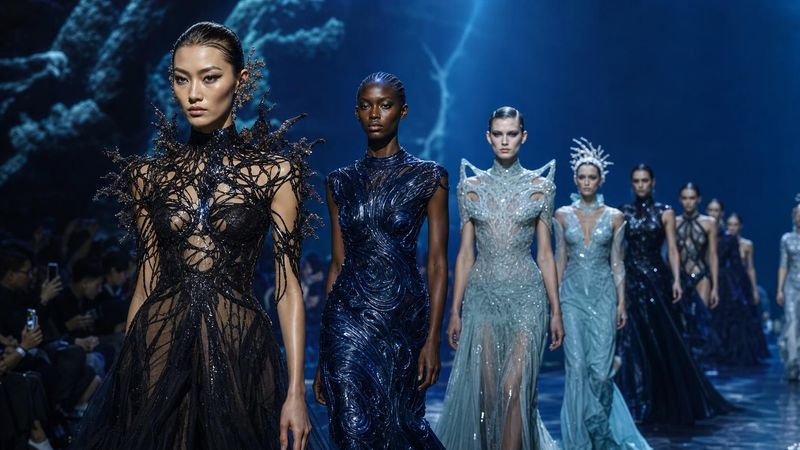
In Paris, during a record heatwave, models walked into latex shells, sculpted bustiers and eerie underwater lighting while editors whispered about wonder, restraint and something more unsettling: the call of the void. At the heart of this Autumn/Winter 2026–2027 haute couture week sat Schiaparelli, with Daniel Roseberry’s collection literally titled The Call of the Void, turning l’appel du vide into a couture manifesto.
For models, this was not just another viral runway moment. When critics and insiders frame a whole couture season around ideas like risk, control and stepping into the unknown, they are quietly updating the checklist for who feels editorially relevant and who gets to build a long-term luxury career. The clothes change every six months; the expectations of the people wearing them shift more slowly, and those shifts are what matter.
Inside Paris Haute Couture’s ‘call of the void’ moment
Paris haute couture week is already fashion’s most intense stage, but AW26–27 pushed it further. Big maisons and small independents kept to the schedule despite brutal heat, long fittings and heavy, technically complex looks. Schiaparelli’s The Call of the Void became the symbolic centre of that energy: a collection born from creative paralysis after a hit season and a decision to lean into uncertainty instead of repeating a formula. Latex, silicone, sculpted paint, dried flowers and fish-scale textures were cut and finished with old-school couture precision, then lit and styled as an underwater dream where models looked almost more creature than human.
In parallel, other houses doubled down on different poles of the same conversation. Dior and Armani Privé focused on restraint, sculpture and controlled silhouettes. Chanel leaned into fairy-tale storytelling and fantasy codes. A Business of Fashion podcast episode dedicated to this week summed it up as wonder, restraint and the call of the void. That language matters, because it describes not just the clothes but how the industry wants fashion – and the people wearing it – to feel in a world of algorithms, AI images and constant repetition.
What a ‘void’ season really asks of editorial models
When couture moves into surreal territory while showing off ruthless craftsmanship, it changes what magazines and luxury clients want to see in pictures. Editorials and campaigns that follow a season like this tend to favour strong narratives: dream logic, deep-sea fantasies, mythic heroines. Styling can be extreme or even unsettling, with hard, artificial surfaces next to bare skin. The model’s job is to keep the image human and emotionally legible inside all that art direction.
Practically, that means editorial relevance is less about having a “couture face” in the old sense and more about carrying tension. Casting directors and image makers start looking for models who can do things like :
- project feeling through heavy styling, partial masks or exaggerated headpieces without overacting
- hold clean lines and balance in rigid, restrictive or very long silhouettes so the clothes still read as precise rather than awkward
- feel believable in slightly otherworldly scenarios, from abyssal lighting to hyper-glossy latex, while never disappearing behind the concept
If a season’s defining images are models as sea goddesses or surreal sculptures, then the faces that book next are usually the ones who showed they could live inside those stories instead of just wearing them.
Using wonder, restraint and void to build a long-term luxury career
The wonder / restraint / void triad is a useful framework for how casting quietly evaluates models after this kind of couture week. Wonder is your ability to be seen inside spectacle: to stay calm, magnetic and readable when you are buried in silicone, feathers or ornate jewellery. Restraint is technical discipline, the Dior or Armani quality of a walk that is clean and economical, posture that protects the garment, composure that holds even under heat, long hours and last-minute changes. The void is your capacity for creative risk, stepping into fittings and shoots where the concept is not fully clear and still bringing instinctive, nuanced expression beyond the usual pretty, sexy or happy.
Translating that into a career plan starts with how you package yourself. In your book and digitals, you need at least one stripped-back image that shows restraint – simple styling, flawless line – and one story or test where the styling is more surreal but your face and body language stay controlled. A third, more experimental shot can hint at your comfort with the void, whether through unusual lighting, angle or mood. With your agency, use references from this couture week to position yourself: if you thrived in sculptural, quiet looks, you may align naturally with houses that prize discipline; if you came alive in Schiaparelli-style fantasy, target photographers and magazines that lean into concept work. Treat podcasts from industry platforms and maisons as free fashion school, so when you sit in a casting or fitting you can talk about these collections and ideas fluently. Over time, models who consistently show wonder, restraint and a healthy relationship to the void are the ones clients trust not just for a single headline show, but for editorials, campaigns and eventually ambassador roles long after the heatwave cools.