Saint Laurent confirmed Friday morning that Anthony Vaccarello is leaving as creative director, ending a decade-long run that turned the Paris house into one of fashion’s most controlled and recognizable visual brands. “I would like to express my sincere gratitude to Anthony for his contribution to Saint Laurent over the past 10 years,” said Luca de Meo, chief executive of Kering, the group that owns the house.
Saint Laurent said it will announce new creative leadership soon. Cédric Charbit, the house’s president and chief executive, credited Vaccarello with lifting Saint Laurent “to the forefront of desirability and image.” For models, agents, and casting directors, the sharper question is what changes next: the campaigns, the runway casting, and the closed circle of faces that defined the Vaccarello era.
A Golden Goodbye, With His Models Beside Him
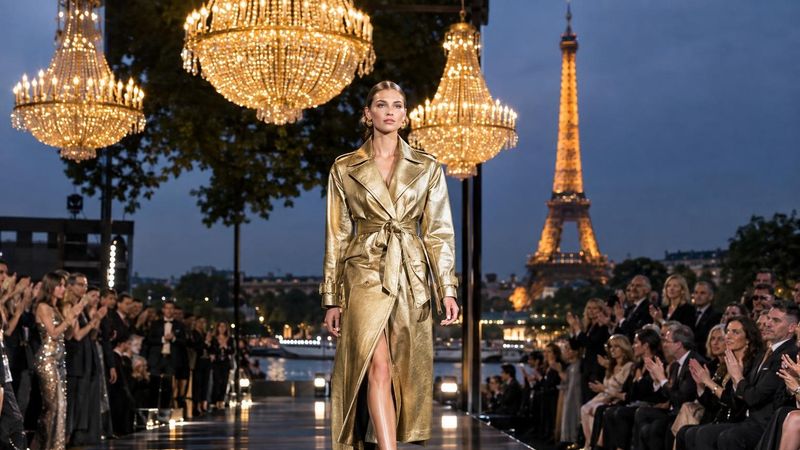
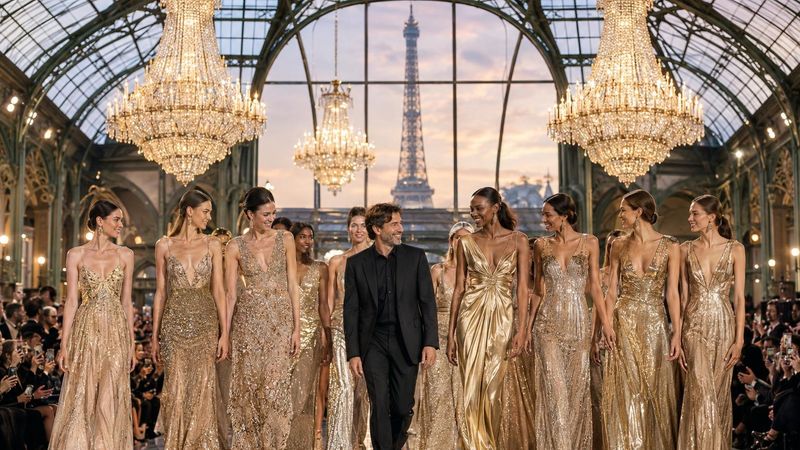
His final show, on September 29, felt like a farewell long before the statement arrived. Vaccarello sent black calla lilies to guests with a note calling the collection personal and emotional, and Miles Davis’s score for Elevator to the Gallows played as the room filled. The spring 2027 collection presented 49 gold looks beneath three monumental chandeliers, with the Eiffel Tower glowing behind, before closing with 10 in black, an inversion of Yves Saint Laurent’s fall 1991 Rive Gauche finale. Charlotte Gainsbourg appeared for a surprise performance at the end.
The image that matters most for casting came at the bow: Vaccarello walked out surrounded by his models, a staging that captured how the house worked for ten years. A tight group of faces carried the runway, the campaigns, and the red carpet at once.
The Faces and Codes of the Vaccarello Decade
Vaccarello arrived in April 2016, four days after Hedi Slimane’s exit, and built his Saint Laurent around sharp tailoring, strong shoulders, leather, faux fur, bold color, and heels. He kept the image under tight control, from monumental sets to party photography published only in black and white. Handbags almost never appeared on his runway.
His inner circle mixed supermodels, actresses, and musicians: Kate Moss, Anja Rubik, Zoë Kravitz, Charlotte Gainsbourg, Madonna, Bella Hadid, and Hailey Bieber, alongside house legacies Catherine Deneuve and Betty Catroux. The singer Rosé became one of Saint Laurent’s most visible red-carpet faces. In one night at the 2026 Met Gala, Vaccarello dressed Zoë Kravitz, Hailey Bieber, Madonna, and Doja Cat. The archetype he favored stayed consistent: long, linear, grown-up, and nocturnal. Saint Laurent Productions, the in-house film arm he launched in 2023, pulled actors, musicians, and models into the same image system, working with directors including Jim Jarmusch, Pedro Almodóvar, and Jacques Audiard.
What the Reset Means for Campaigns and Casting
The decision, Kering told analysts, was driven by long-term prospects rather than recent financial performance, according to a Barclays note, and the group outlined where the next designer should focus: women’s daywear, menswear, high-end leather goods, jewelry, and growth in China and Asia. That brief translates into casting. Daywear calls for a different silhouette and energy than eveningwear, a menswear push means more male faces and more men’s campaign slots, and Asia growth raises the bar for representation that resonates in those markets.
Chemena Kamali, now creative director at Chloé and Saint Laurent’s women’s ready-to-wear design director from 2016 to 2023, is widely expected to succeed him, though nothing is confirmed. Her Chloé work leans romantic and fluid, a contrast to Vaccarello’s severity. Models currently tied to the house face both risk and reinterpretation, since no face is guaranteed continuity across a creative handover. The first campaign and the first full runway of the new era will reveal the real brief.