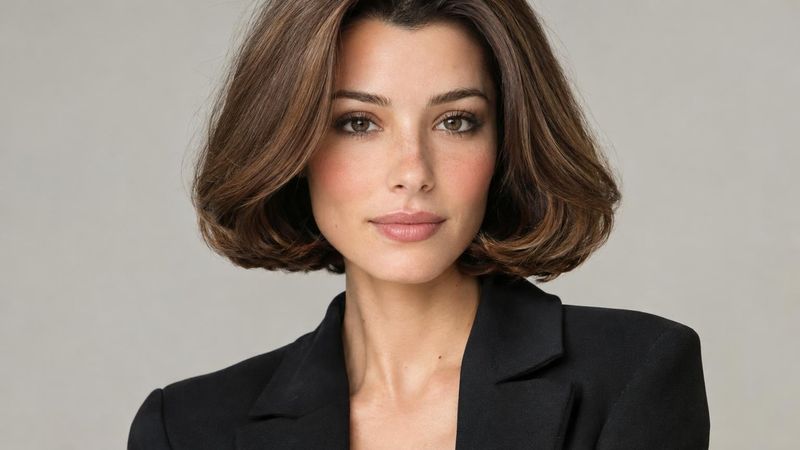
Of all the hairstyles that shaped the 1990s, only one moved as easily between a Paris runway, a network sitcom set and a tabloid front page. The bob, cut between the jaw and the shoulder, blown out for volume and finished with the ends turned under, became the decade’s most photographed silhouette. Vogue’s 23-look retrospective still serves as a reference for stylists, photographers and casting directors, and the roster it records remains the benchmark the industry measures a bob against.
What set the cut apart was the finish rather than the length. Hair sat full at the temples, brushed into a rounded line, with the ends loosely curled under or lightly flipped, a small styling gesture that made the shape read as polished instead of simply short. And the ’90s bob was never one haircut anyway. It was a family of them, and the differences within that family explain why the silhouette has outlasted nearly every other trend of its decade.
What Made the ’90s Bob Different
Length landed between the jaw and the shoulder, a band wider than it sounds. A chin-grazing cut and a collarbone-grazing one share a name but not a mood. Three variants fill most of the roster: the symmetrical, blunt bob worn close to the jaw, the blown-out bob with volume at the crown and temples, and the tousled bob, styled to look as though it had survived a car window.
Light layering kept all three versions working. Heavy layering pulls weight from the ends and collapses the shape, while a properly cut bob holds its volume low, and the under-curl draws a soft horizontal line across the jaw. That line frames a face in a photograph. It is also the reason the cut can read as glamorous in print with nothing more than a round brush behind it.
The Supermodel Bob, Built for the Camera
Christy Turlington wears the earliest dated entry in the roster, from 1991, and her version sets the template: blown out, rounded, and soft enough to move. Naomi Campbell’s 1996 bob takes the opposite route, symmetrical and blunt, with a part sharp enough to split a runway look in half. Linda Evangelista, photographed with bob-length hair in 1994 and again in 1996, makes the case for the cut as a chameleon’s tool.
For models, the choice was never purely aesthetic. A distinctive silhouette makes a face recognizable across a season in which the same woman appears in dozens of shows and campaigns, and a clean line survives both flash photography and a walk under runway lights. Editors can restyle a good bob three ways in an afternoon. Versatility of that kind is a professional asset, and the supermodels of the era treated it as one.
How Hollywood Turned the Bob Into a Salon Request
Television and film carried the cut from the runway into the salon chair. Meg Ryan wore it in 1995, the same year Jennifer Aniston’s layered, shoulder-grazing version turned appointment books into waiting lists. Drew Barrymore appears twice in the roster, in 1993 and 1997, with a softer and messier take on the same shape. Cameron Diaz closes the decade’s entries in 1998 with a tousled, unhurried finish.
Range matters as much as star power here. Nia Long in 1994 and Tracee Ellis Ross in 1996 show the bob working across textures and movement, not only on straight, blown-out hair. Styled against a slip dress, a white tee or minimal tailoring, it reads as deliberate, which is part of why these photographs keep circulating as moodboard material decades later.
When a Signature Cut Becomes a Career Asset
Ask a working model what her haircut is worth and the answer is rarely about money. A strong silhouette is branding. It appears in the book, in digitals, in the walk, and it is often the detail a casting director recalls a week after the meeting. Agents discuss it in practical terms: does the cut open editorial and campaign work, or does it narrow the range a client can sell?
A boy bob worn through years of bookings works precisely because the silhouette is distinct enough to be remembered and flexible enough to be restyled. Change the cut and the market reads it as a business decision. Going shorter can signal an editorial turn. Growing it out can signal a pivot toward commercial work. Either way, the hair sits inside the negotiation, alongside the book and the walk.
Why the Silhouette Keeps Coming Back
Runway seasons return to the shape in cycles rather than revivals. Collections at Jil Sander, Coach and Willy Chavarria have styled the blown-out, rounded bob with a round brush, and the result reads less like nostalgia than a standard being restated. Contemporary wearers such as Selena Gomez, Gracie Abrams and Lily Collins treat the inward-curled bob as a personal trademark, in the same way the roster’s supermodels treated theirs.
If the cut is the goal, ask for a person rather than a trend. Name a specific frame: Turlington in 1991, Campbell in 1996, or an image from the roster that matches your own texture and density. Bring two or three references, be honest about how much time you will spend with a round brush, and decide in advance whether the ends turn under or flip out. The finish is the look.