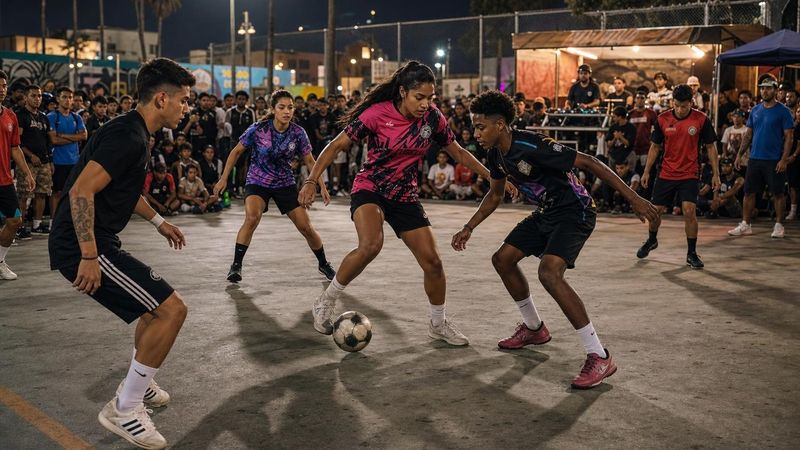
On a warm night in Los Angeles, the sun drops behind the Pacific and the floodlights switch on along Ocean Front Walk. The basketball courts and skatepark at Venice Beach are already icons. Now, a different rectangle of concrete pulls focus: a fenced street pitch where four‑a‑side games unfold at full speed, music shaking the boardwalk and a crowd pressed tight to the sidelines.
This is the atmosphere many people now associate with street soccer Los Angeles. Flagship events like Toma La Noche bring together teenage players from across the county, scouts in the stands and DJs on stage. Behind the spectacle sits a deeper story about who owns the game, how LA’s diasporas shape it, and why this concrete court has become a runway for style, identity and opportunity.
Venice Beach, the new landmark of LA street soccer
The modern epicentre is the Venice Beach Football Club court, designed as a permanent street soccer space a few steps from the sand. Painted lines, low walls and tight dimensions turn the pitch into a kind of outdoor studio. Tourists stop for photos, but locals know it as a training ground, a meeting point and, on tournament nights, a full community arena.
Nike’s Toma El Juego platform chose Los Angeles for its launch in 2025 and has since used a mini‑tour to map the city through football. The first stops were The Lawn in Compton and the 6th Street Bridge downtown before landing in Venice. Eight neighborhood teams of boys and girls aged 14 to 18 play a knockout format, free to enter and to watch. Names like Culture FC, Football For Her, La Comunidad or Tiki-Taka Futbol read almost like streetwear labels, each representing a slice of LA.
Street soccer in LA: smaller pitch, bigger imagination
To understand why this matters, it helps to know what street soccer is not. It is not eleven‑a‑side with referees, benches and rehearsed patterns. On a street court there is no time for line‑ups on a tactics board. The game rewards invention. Soccer entertainer Elischa Edouard describes it simply: the space shrinks, but the mind expands. With the ball never far from a wall, a body or a nutmeg, every touch invites improvisation.
Freestyler Janella Hernandez talks about freedom and style as the defining features. Players try moves they would never risk in a traditional match: elasticos, drag backs, spins that land inches from a concrete burn. In older parking‑lot games, this was almost a quiet counterculture, closer to skate crews than club academies. Fakes and counterfeit shirts were part of the look, and respect came from a perfectly timed sombrero rather than the final score.
Community, diaspora and a new pipeline of talent
Street soccer in Los Angeles is inseparable from migration. Los Angeles County has the largest Hispanic population in the United States, and many families arrived with football already woven into daily life. Content creator Megan Reyes remembers the first Toma nights as a celebration of LA’s Latino community, from the food stalls to the Spanish bouncing through the crowd. Hernandez recalls neighborhood teams playing each other long before any global brand showed up with floodlights.
According to the Pew Research Center, most teenage Hispanic players are still boys, yet participation among girls has surged in recent years. Other data from For Soccer points to an 82 percent year‑on‑year rise in Hispanic girls’ participation and a 185 percent increase since 2021. Crews like Football For Her make that visible at tournaments, where the girls’ brackets are as intense as the boys’ and risk‑taking is encouraged, not policed.
The pathway into elite structures is no longer theoretical. At the LA finals in 2025, MVPs Noe Morales and Jennifer Alvarez signed two‑year athlete deals with Nike and joined a US Soccer Talent ID camp. On the national stage, diversity has followed. The US men’s team went from two Black players at the 1990 World Cup to a record 12 in 2022. The 2023 women’s squad included a record number of Black and Mexican American players. Initiatives rooted in street soccer culture help put more eyes on talent that once stayed hidden on back‑lot asphalt.
Concrete runways: style, branding and the future of the scene
Look closer on a Toma La Noche evening and only part of the story is on the ball. Reyes estimates that most of the event happens “off the ball” in the way players dress, braid their hair, paint their nails or stack jewelry that flashes under the lights. Kits mix with vintage jerseys, cut‑off shorts, team socks and limited sneakers. Local streetwear brands drop small capsule collections around the tournaments, from graphic tees to custom warm‑ups, turning the sideline into a live lookbook.
This is exactly why brands are paying attention. For global sportswear, the Venice court is a laboratory where future campaign images walk past in real time. Collaborations with labels founded by children of immigrants, or with community clubs like VBFC, give collections a story that travels further than a studio shoot. For casting directors, these spaces are a shortcut to the real thing: players whose movements, scars and confidence cannot be manufactured in a casting call.
The flip side is a tension that many in LA feel. Street soccer began as a rebuke to polished stadium football, a “football of the parking lots” where anyone could play. Fresh paint, perfect branding and camera cranes risk smoothing out the rough edges that made it powerful. Community organisations like Street Soccer USA, and projects such as Visa-backed street soccer parks in underused LA spaces, try to keep access at the centre with free programs, local coaches and support beyond the game. Coaches, parents and volunteers act as quiet gatekeepers of the culture, reminding everyone that the point is still kids from the neighborhood finding a place to move, express and connect.