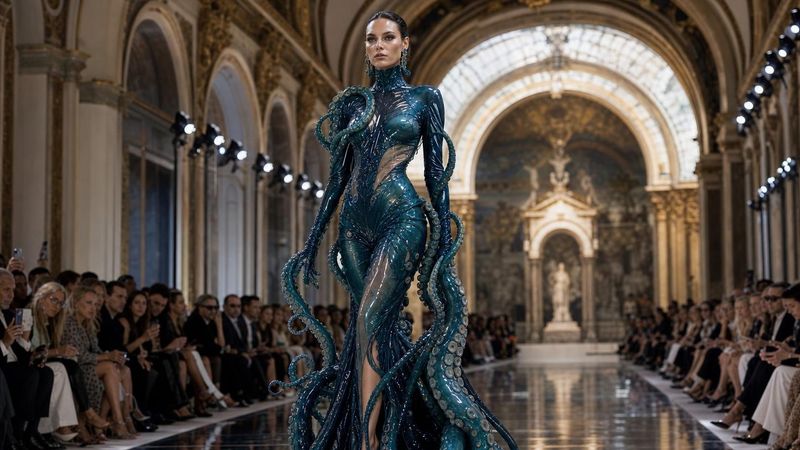
At the Petit Palais in Paris on July 6, the Schiaparelli Fall 2026 couture show opened Haute Couture Week with a jolt of beauty and horror. Under the gilded ceilings, Daniel Roseberry sent out a collection titled “The Abyss”, built around an underwater nightmare of latex tentacles, silicone skins and mirrored vertigo. The morning slot on the official calendar suddenly felt anything but gentle.
Coming off last season’s hit “The Agony and the Ecstasy”, Roseberry admits he tried to repeat a winning formula and hit a wall. Letting go of that safety net, he leaned into what he calls “l’appel du vide”, the call of the void. The result is a collection that looks both exquisitely crafted and deliberately unsettling, raising the question of how far couture can push into horror without losing its beauty.
Paris Couture Week Opens in Schiaparelli’s Abyss
Guests arrived to find a catwalk that was not a traditional runway at all but a long mirror, reflecting the painted vault of the Petit Palais and exaggerating every step. In a recorded monologue played before the show, Roseberry spoke about feeling as if he were driving off a cliff, which set the tone for this idea of creative vertigo. The front row reinforced the moment’s weight, with Emma Corrin, Michelle Yeoh, Bad Bunny in butter-yellow tailoring and stylist Law Roach turning the opener into an instant fashion headline.
Taking this coveted first slot means setting the emotional temperature for the entire week, ahead of houses like Dior and Chanel later in the schedule. Roseberry, now seven years and roughly fifteen couture outings into his tenure, answered that pressure with an oceanic universe rather than a safe replay of past successes. Shell jewels, urchin-like sandals, a fully pearled trouser and jackets sprouting painstakingly sculpted tentacles suggested creatures rising from the deep, without ever slipping into costume drama.
When Couture Flirts With Horror: Latex, Silicone and Synthetic Skin
Instead of the usual couture mix of silk, satin and wool, Schiaparelli leaned hard into latex, silicone and baked sheets of paint shaped into rigid shells. High-gloss latex pumps were embroidered with pearls like evening taffeta. A sharply cut jacket appeared to drip in transparent silicone that caught the light like jellyfish flesh, giving traditional tailoring a strange, liquid depth. The message was clear: luxury here is not the fiber itself but the hours of handwork that make these lab-born materials feel almost alive.
That is where beauty twisted toward horror. A black latex column sprouted looping octopus forms that wrapped the torso like a parasite. An urchin bodysuit bristled with spikes and beads that read both precious and predatory. In the draped folds of certain gowns, ghostly masks peered out, a sly nod to horror cinema hidden inside museum-level craft. Then the tension softened with silicone anatomical bustiers on Karlie Kloss and Alex Consani, molded like hyper-real skin above ombré floral skirts, one of which went straight to Zendaya for a red carpet hours later.
The Models Carrying Schiaparelli’s Beautiful Monsters
The casting matched the scale of the clothes. Kris Krystal opened the show, her height and stillness amplifying the sense of a figure emerging from the depths, while Ivy Stewart closed in a finale look that read almost like armor. Between them, a lineup including Karlie Kloss, Anok Yai, Alex Consani and Amelia Gray delivered the mix of statuesque proportions and graphic features this kind of imagery demands. These are bodies that can sell couture yet still look slightly otherworldly.
For the models, the horror was technical rather than emotional. Walking a mirrored runway in towering heels, inside latex exoskeletons or skirts weighted with pearls, demands core strength, balance and a slower, almost ceremonial pace. Arms pinned by sculptural jackets or framed by tentacles limit natural swing, so every turn has to be rehearsed until it feels instinctive. For aspiring models, shows like this are a reminder that couture casting now favors faces who can handle concept pieces as if they were second skin, turning difficult constructions into fluid motion and, in the process, anchoring some of the most talked-about images of the season.