Beige jeans spent years as the riskiest purchase in the denim aisle: too close to white to feel practical, too pale to read as real denim, too easy to get wrong. That reputation has faded. Beige sits alongside indigo, black, and ecru as a legitimate wardrobe neutral, and it solves something the other three cannot. It softens a fall outfit without making it look like summer refused to leave.
The catch is real. Pale denim, a pale top, and pale skin can flatten a frame in daylight and vanish in a phone snapshot. The fix is not a different pair of jeans. It is contrast, placed deliberately near the face and at the edges of the outfit. Get that right and beige becomes the most useful denim you own.
Why Beige Denim Stopped Being a Compromise
The color has been climbing for years, first through camel coats and tailored trousers, then into denim. What pushed it from styling experiment to default was runway cover. Loewe, Celine, Miu Miu, and Polo Ralph Lauren have all sent beige pants down recent fall/winter collections, which turns a street-style habit into an industry position.
Beige occupies useful middle ground. It is softer than crisp white, which fights with cold-weather textures, and lighter than dark brown or black, which pulls an outfit toward evening. That middle position is why stylists treat it as a blank canvas: with other neutrals it reads minimal, and with strong color or print it lets the accent do the talking.
What Beige Does Better Than White or Indigo
Three practical advantages hold up. Beige flatters the leg line rather than highlighting it. White denim reflects light and draws the eye to every seam, while a softer beige cast blends the transition at the hip and knee, so the silhouette reads smoother. It is also more forgiving. A brushed seat or a splash on the way into an appointment disappears into beige and ends a white pair’s day. And the color reads expensive: soft neutrals carry a quiet-luxury signal regardless of price point, which matters in rooms where presentation is part of the work.
The shade you pick matters more than the label.
| Depth | What it does | Washout risk | Best paired with |
|---|---|---|---|
| Light ecru | Crispest, closest to white, most summery | High | Black, navy, burgundy up top |
| Mid-beige | The workhorse, most versatile across seasons | Low | Camel, ivory, denim jackets, tonal looks |
| Deep camel or khaki | Grounded, forgiving in low fall light | Lowest | Ivory, chocolate, olive, rust |
The Washout Rule: Contrast Near the Face
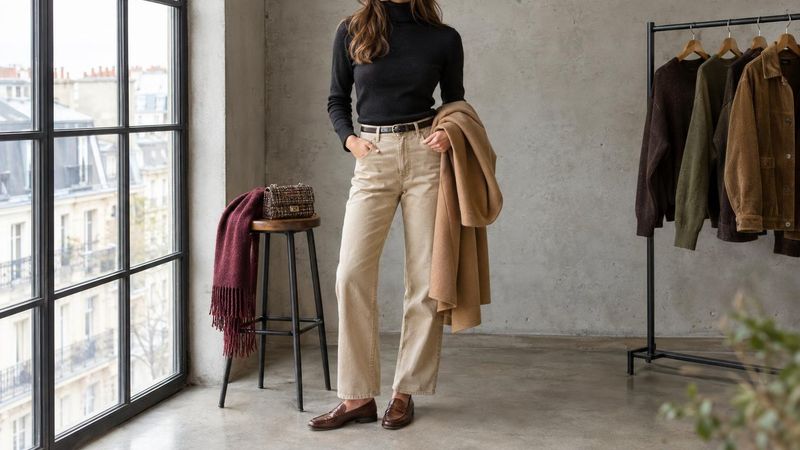
If your skin, your hair, and your jeans sit at roughly the same lightness, you need something darker or brighter within a hand’s width of your face. That single rule handles most of the problem. A black turtleneck, a navy blazer, a sharp collar, a statement earring, a stronger lip, a scarf: anything that pulls the eye upward and re-anchors the frame.
Color pairings do the rest. Jewel tones such as burgundy, emerald, sapphire, and ruby sharpen neutral denim. Fall shades of rust, forest, mustard, and chocolate keep it seasonal. Deep neutrals in charcoal, black, espresso, and navy give the cleanest, most editorial result. Two of those per outfit is plenty.
Texture works when color does not. A beige column in smooth cotton, fine knit, and glossy leather still reads flat. Swap one layer for tweed, shearling, corduroy, cable knit, or leopard print and the outfit gains edges. Contrast of surface counts as much as contrast of color, especially under flat indoor lighting.
Outfit Formulas That Travel Well
- Tonal with an accent: beige jeans, camel knit, chocolate loafers, burgundy shoulder bag.
- Black anchor: straight-leg beige, black turtleneck, black belt, loafers or ankle boots.
- Trench moment: deep brown trench, ivory boatneck top, ballet flats or low sandals while weather allows.
- Preppy, sharpened: wide-leg beige, white shirt, navy blazer, pointed boots.
- Refined maximalism: fine-twill beige that nearly passes for chinos, blue button-down, red flats, leopard tote.
Silhouette decides how the color lands. Barrel and balloon legs add volume at the calf and need a slimmer or cropped top to balance them. Relaxed straight legs are the everyday workhorse. Wide legs lengthen when the hem breaks just above a boot or heel. Rigid, non-stretch denim breaks in and molds to the body without bagging at the knee, which is why it holds this color better than stretch blends.
On Camera, at Castings, and Through the Week
A head-to-toe tonal beige look can be beautiful in a mirror and muddy on a phone screen. For go-sees, castings, and any day that ends in a snapshot, mid-beige denim with a defined top and a clean shoe photographs better than a full tonal column. Press the jeans, check the hem against the shoe you plan to wear, and keep one strong element in frame: a dark knit, a structured jacket, a visible belt.
The same pair then carries an entire week. With a white tank and sandals it covers warm afternoons. With a camel coat and ankle boots it handles the cold. With a grey crewneck and a knit tied over the shoulders it reads weekend. One pair, three contrast levels, no repeated outfit. That flexibility is the real argument for beige denim, and the reason it keeps outlasting the seasons that supposedly introduced it.