Carla Fernández’s fashion house operates out of Mexico City. Her home does not. Casa Flora stands in Mérida, Yucatán, inside a building that has lasted more than a century, and she led the renovation herself, shaping it into a colorful brutalist home and studio that also serves as a base for Taller Flora, her design lab.
The house appears in Mesoamerican Modern: Ancient Ideas in Contemporary Mexican Homes, the Phaidon Press book by Mexico City-based writer and curator Su Wu. The volume gathers 16 homes across Mexico, all photographed by Luis Garvan, with Casa Flora occupying pages 244 to 263. What it documents is not a museum-style revival of pre-Hispanic design. It is a working system, one where a designer lives inside the same techniques her collections depend on.
Inside Casa Flora, a Century-Old House in Mérida
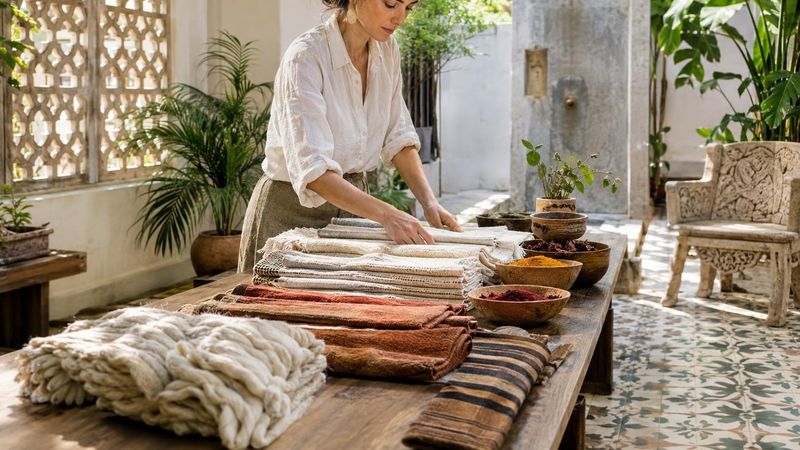
Fernández works as both a fashion designer and a historian. For roughly twenty years she has studied, preserved, and revitalized the textile heritage of Mexico’s Indigenous communities. Taller Flora is her vehicle: a studio that includes a fashion label and a set of mobile design workshops. She travels the country to visit hand-spinners, weavers, embroiderers, and garment makers, documenting backstrap-loom weaving, natural dyeing, embroidery, geometric structuring, pleating, and folding.
The house hosts workshops for Taller Flora and holds a home, a studio, and a meeting place in one footprint. Recognition has followed. In 2013, she was one of 11 recipients of the Amsterdam-based Prince Claus Award, which honors artists whose cultural actions benefit their communities. The fashion house has been a certified B Corp since 2018, and the label has shown at the Isabella Stewart Gardner Museum in Boston and the Jumex Museum in Mexico City.
Rooms That Read Like a Living Textile Archive
Mesoamerican art and textiles fill the home, and the pieces trace back to named communities rather than a generic regional style. Fernández has built long-term working relationships with Tzotzil weavers from San Juan Chamula, Otomí artisans from San Pablito and El Nanthe, Amuzgo weavers from Xochistlahuaca, Nahua makers from Hueyapan, and Zapotec weavers from Teotitlán del Valle in Oaxaca.
Those relationships carry economic weight. About 90 percent of Mexican artisans are women, and most of them are family breadwinners living below the poverty line, according to the arts organization SITE Santa Fe. The collaborations are structured so artisans earn income from the work and receive credit for it, which separates this house from interiors that treat handmade cloth as surface decoration.
The Square Root: Geometry That Moves From Cloth to Concrete
Fernández’s pattern system has a name: la raíz cuadrada, the square root. Western tailoring builds from curves and cut silhouettes that emphasize the body. Mexican Indigenous garments are assembled from square and rectangular panels instead, joined with folds, pleats, and stitching in what her studio calls a textile origami. The brand’s manifesto treats the garments as documents: they “can be read like open books that tell the life stories of the weavers who made them.” Cut out a page or divide it with seams, and the story stops reading.
The quechquemitl makes that logic easy to see. In Nahuatl, quechtli means neck and tlaquemitl means garment, and the piece is made from two squares folded into triangles that cover each side of the torso, with corners worn at the front and back or sloping down along the arms. Casa Flora runs on a version of the same geometry. Su Wu points to the patio as the clearest example, drawing on how architects from Teodoro González de León onward described it: “a central, defining feature of the Mesoamerican home, a space that is at once enclosed and open to the elements.” In this house, Wu told Vogue, the boundary between interior and exterior stops being physical and becomes “a marker of movement across psychological states.”
Pedro Reyes and the Sculpture Built Into the House
Fernández shares the property with the artist Pedro Reyes, and his contributions are structural. He made the concrete outdoor shower and several of the tiles, and his sculptures appear throughout the rooms, including a prototype of the Mitla Sillas, chairs modeled on the pyramids at the Mitla archaeological site in Oaxaca.
That mixture of art, craft, and daily use is the argument the house makes. Elena Reygadas, the chef who wrote the foreword to Mesoamerican Modern, puts it plainly: handmade things “are meant to be lived with no matter how precious, or especially if precious.” Su Wu makes the same case in the book’s introduction, describing how she expected the aura of museum artifacts and found instead “the vibrant, living presence of Indigenous ideas in Mexico.”
The Studio Model Behind the Rooms
For anyone following how independent fashion houses operate, Casa Flora runs on documentation. The trips across Mexico produce an archive of techniques. That archive feeds new designs, which are produced with the artisans who supplied the knowledge. Income flows back to those communities, and the B Corp certification holds the company to measured standards across governance, workers, community, and environment.
The research also travels as a book. The Barefoot Designer: A Handbook, published in 2014, gathers the Indigenous and mestizo textile traditions the studio draws from, and its title nods to Johan van Lengen’s The Barefoot Architect: A Handbook for Green Building. The handbook and the house keep the same techniques visible, credited, and in use.