Every model learns early that UV exposure does not pause for call sheets. Castings happen on sidewalks, editorials happen on rooftops and beaches, and Fashion Week runs through cities where the sun ignores your schedule. Sunscreen is the one product that belongs in every working bag, and often the one most people apply too thinly to matter.
A guide Vogue published on the different types of sunscreen settles a question that comes up constantly backstage: with dozens of formulas on the shelf, which ones actually earn space in a kit? Dermatologists tend to give the same answer, that the best sunscreen is the one you will genuinely use every day. For working models, the smarter move is to stop shopping by brand and start choosing by format, matching each product to the part of the job it has to survive.
Mineral vs. Chemical: The Two Types of Sunscreen, Explained
Two families cover the market: mineral and chemical. Mineral formulas, also called physical sunscreens, rely on zinc oxide and titanium dioxide. Marisa Garshick, a board-certified dermatologist at MDCS Dermatology, describes them as scattering and reflecting UV rays before they can penetrate the skin. The upside is gentleness. Mineral filters tend to be the safer bet for reactive or sensitive skin.
Their weakness used to be white cast, the ghostly finish that reads badly under studio flash and looks worse on deeper skin tones. Newer formulations have largely solved it. Lightweight mineral textures blend in cleanly, and tinted or green-toned versions color-correct redness while they protect. Under studio lighting, that correction is a feature, not a workaround.
Chemical sunscreens work differently. Hadley King, a New York-based board-certified dermatologist, explains that they absorb UV rays and convert them into heat that dissipates from the skin. Common filters include avobenzone, octinoxate, octisalate, octocrylene, homosalate, and oxybenzone. Textures are usually lighter, they sink in without a cast, and they layer well under foundation. The trade-off: a minority of people react to certain filters, so patch-test anything new before a shoot week.
The newest filter in US formulas is bemotrizinol, known as BEMT. Krupa Koestline, the cosmetic chemist who founded KKT Innovation Labs, has described it as a single filter that absorbs both UVB and UVA, rather than a stack of ingredients covering the spectrum. UVA drives the fine lines and pigmentation that cameras catch first, so the wider coverage matters. Bemotrizinol has been used abroad for decades, and Vogue’s guide notes it has recently been cleared for US products.
Sprays, Sticks, and Powders: Which Format Fits the Job
Format matters as much as filter. Sprays are built for bodies and hard-to-reach areas, from shoulders to the backs of legs. King recommends holding the nozzle close, spraying until the skin visibly glistens, then rubbing it in evenly. One ounce covers a full body, which means a standard six-ounce bottle holds roughly six applications. That math matters on a multi-day shoot, where a shared bottle can empty by lunch.
Sticks handle precision. They suit the face, ears, hairline, hands, and tattoos, and they travel without leaking. The weakness is dosage: it is nearly impossible to measure a full serving from a solid format. The American Academy of Dermatology recommends four back-and-forth passes over each area of skin, then blending for an even layer.
Powders are the reapplication specialists, especially over makeup. Brush-on formulas built on zinc oxide or titanium dioxide let you top up through a long day. They are never a base layer, though. King points out that “It is difficult to apply enough powder to achieve the initial SPF protection,” and she advises pairing powder with a broad-spectrum SPF 30 or higher lotion or cream underneath.
Reapplying SPF on Set Without Losing the Look
The two-hour rule does not bend, and the clock restarts after swimming or heavy sweating. On set, that creates a real problem: how do you reapply when a full face of makeup is already finished?
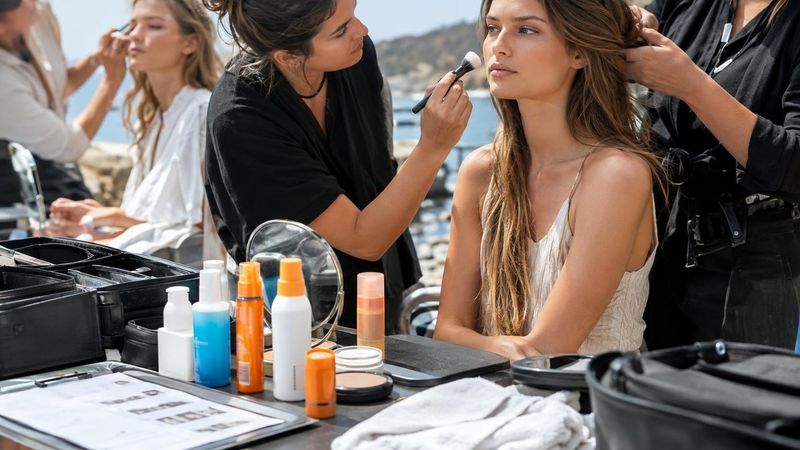
The workable order starts before call time. A generous layer of SPF on clean skin, a few minutes to set, then makeup on top. Once the look is finished, touch-ups stay on the perimeter: a stick along the hairline, ears, jaw, and hands, and a powder pressed through the T-zone. Body coverage gets sprayed and massaged in, kept away from the face.
Outdoor work changes the math again. Beach and pool editorials call for water-resistant formulas and reapplication every two hours without exception. Winter shoots are the sneaky ones, because snow reflects UV upward and altitude adds intensity. A clear stick in a coat pocket solves most of that.
The Four-Product SPF Kit Worth Carrying
Most working bags do not need a dozen sunscreens. They need four: one daily face formula you genuinely enjoy wearing, one body lotion or spray, one portable stick, and one powder for touch-ups. Choose the face product by skin type and tone, the body product by convenience, and the extras by what you will reach for without thinking.
- Daily face: a lightweight chemical or BEMT fluid, or a tinted mineral that doubles as a primer.
- Body: a spray for speed on big jobs, a lotion for staying power on long ones.
- Touch-up stick: clear or mineral, ideally water-resistant for outdoor days.
- Powder: brush-on SPF for reapplying over a finished face without disturbing it.
Filters get approved, textures improve, and packaging changes every season. The four slots stay the same. A product that lives in your bag and gets used daily beats a perfect formula left on a shelf, and that rule outlasts every launch.