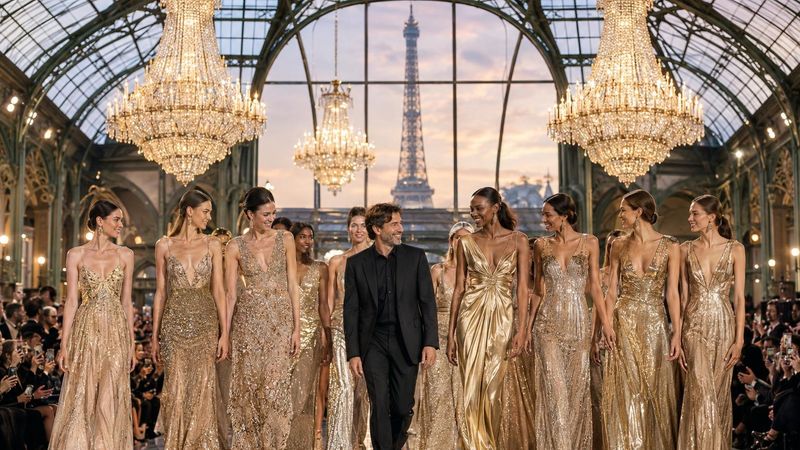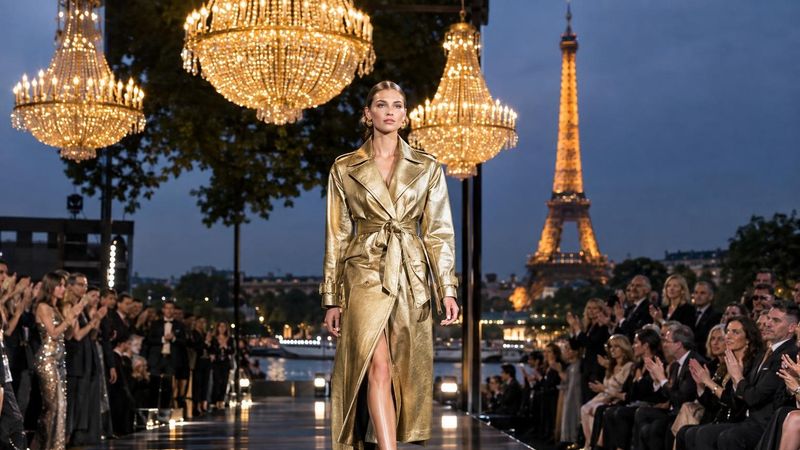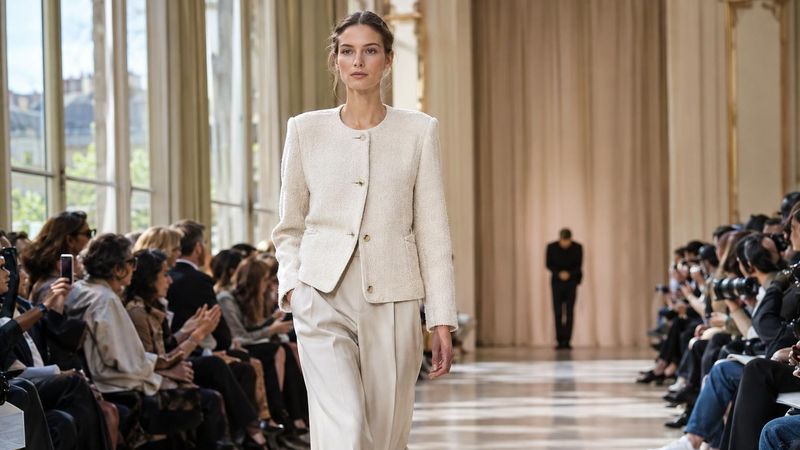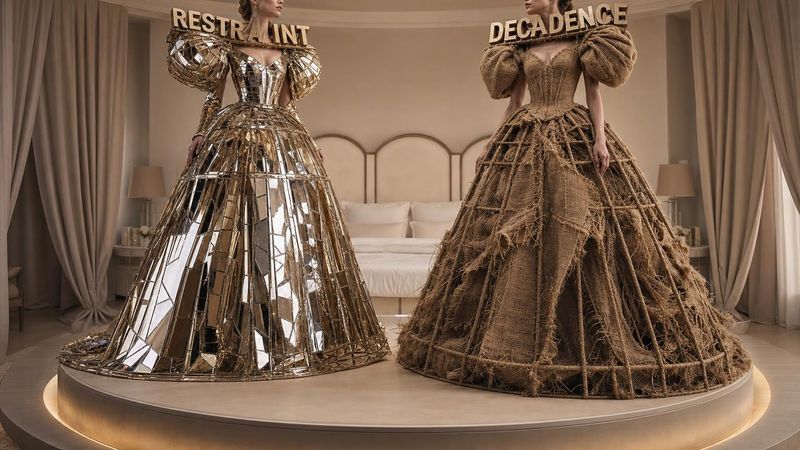
Viktor & Rolf’s Fall 2026 couture show, titled Gilded Age 2.0, looked like a short art film playing out on a circular bedroom stage at Paris Couture Week. Two models, Nathalie Haerlemans and Elpida Voryas Georgiadi, moved in near-synchronised unison, dressing and undressing themselves from garment bags, boxes and drawers, like mirror images that didn’t quite match.
On the surface it was a clever take on restraint versus decadence: one wardrobe in matte burlap, the other in glittering gold and sequins, both cut with the same couture precision. Underneath, it read like a casting and posing manifesto. For anyone working in fashion right now, Viktor & Rolf were quietly spelling out what avant‑garde runway, editorial and campaign work will ask of models and image-makers in the coming seasons.
Inside “Gilded Age 2.0”: From Runway to Performance Lab
The set was a circular platform arranged as a bedroom, the kind of intimate space usually hidden from view. Instead of a traditional catwalk, the models stayed inside this orbit, turning the show into a contained performance you could shoot from every angle. That alone is a clue: designers are increasingly staging shows as 360‑degree content, meant to live in stills, video and social clips at the same time.
Each look appeared in two versions. One in shades of gold, heavy with sequins, fringes and shine; the other in rough burlap, reworked in different weaves and weights. Mini‑crinolines tucked into pleats pushed skirts out from the spine, high ruffled necklines framed the face, and mutton‑leg sleeves exploded into ruffled roses that grew from flat origami shapes into full three‑dimensional blooms. The final pair carried the words “Restraint” and “Decadence” as 3D lettering perched on their shoulders, like wearable captions. For casting and editorial teams, the message is clear: runway is now a story told by bodies in a set, not just clothes on a path.
Two Models, One Mirror: The Era of the Performer‑Model
Choosing to build an entire couture show on just two women is a radical casting decision. Haerlemans and Voryas Georgiadi didn’t simply walk; they mirrored each other, dressed without assistance, and maintained a shared rhythm while handling heavy, structured garments. This kind of role needs more than a strong walk. It calls for presence, memory and the ability to perform a score of movements with tiny variations.
For models and agents, Viktor & Rolf’s Gilded Age 2.0 is a signal that performer‑skills are no longer a niche. Dance, theatre and performance training translate into better control over timing, breath and micro‑expression — all crucial when you are both character and hanger. For casting directors, it opens up briefs that ask for pairs or trios who can sync, improvise around choreography, and hold a narrative over 15 or 20 looks instead of one turn down a runway.
Restraint vs Decadence: A Built‑In Casting and Editorial Brief
Every look in the show existed as a double: one ostentatious, one “humble”, both intensely worked. Beaded fringes on a gold minidress were echoed by painstakingly frayed edges on its burlap twin. Sequined surfaces found their counterpart in trails of tiny French knots and bows. Even the rose‑covered coat shifted from geometric, Mackintosh‑like motifs at the hem into rounded blossoms at the shoulders in both fabric stories.
Read as casting archetypes, “Restraint” and “Decadence” become two roles. The restrained persona holds tension, stays contained, plays with stillness and internal drama. The decadent persona expands, luxuriates in the space, exaggerates gesture and eye contact. Editorially, this is a ready‑made framework: duo stories that pit gold against burlap, campaigns where one model moves from one side of the spectrum to the other, or videos that split the frame into two contrasting timelines. The show behaves like a moodboard already translated into bodies, silhouettes and attitudes.
Posing for Extreme Silhouettes: When the Dress Is the Architecture
Viktor & Rolf’s couture relies on structure: mini‑crinolines at the back, tiered skirts, inflated sleeves, sculpted roses, dense embellishment and even solid 3D words perched on shoulders. These pieces do not follow the body; the body has to negotiate with them. For models, that changes the posing rulebook.
With this kind of volume, the most effective poses are often slower and more architectural. Profiles and three‑quarter angles show the engineered curve of a crinoline. A neutral, grounded stance lets heavy sleeves and shoulder pieces read cleanly on camera. Sudden twists or collapses can crush the structure or make lettering illegible. Useful habits include shifting weight subtly instead of stepping wide, using hands to frame or support exaggerated shapes without grabbing at them, and keeping the neck and jaw relaxed so the face doesn’t fight the drama already happening in the clothes.
From Runway to High‑Concept Editorial: How to Use This Blueprint
The circular bedroom set and “imperfect mirror” pairing are ready to be recycled into shoots. A photographer or creative director can translate the concept into a studio by building a semi‑circular layout of furniture and props, then restricting the model’s movement to that arc. The limitation forces narrative: you see someone living through multiple emotional beats in one confined world, just as Haerlemans et Voryas Georgiadi did on the platform.
For high‑concept editorials, there are obvious lifts from Gilded Age 2.0: two models dressing themselves in shot, a single model styled as both restraint and decadence in alternating frames, or an image sequence where craft details — frayed hems, origami roses, dense knotting — are treated like close‑up portraits. Social media edits can mirror the runway concept too, with split‑screen Reels contrasting gold vs burlap looks, or time‑lapse clips of a model cycling through escalating silhouettes inside the same fixed set.
What Models and Agents Can Take Away
The Viktor & Rolf Fall 2026 couture casting doesn’t replace traditional runway overnight, but it does point toward where the most interesting jobs are heading. Smaller, more demanding casts; roles that blur model and performer; silhouettes that require technical body awareness; and show formats designed from the start to be filmed from every direction.
For models, that means investing in skills that read across all of this: movement classes, comfort with improvisation, and portfolio work that proves you can handle sculptural shapes, conceptual sets and duo or group chemistry. For agents and coaches, it is a prompt to push talent toward test shoots that feel more like short stories than lookbooks. Couture may still be the laboratory, but as Gilded Age 2.0 shows, what happens there quickly becomes the silent casting brief for the rest of the industry.